
Immediate Post-Storm Safety: Assessing Hazards and Triage
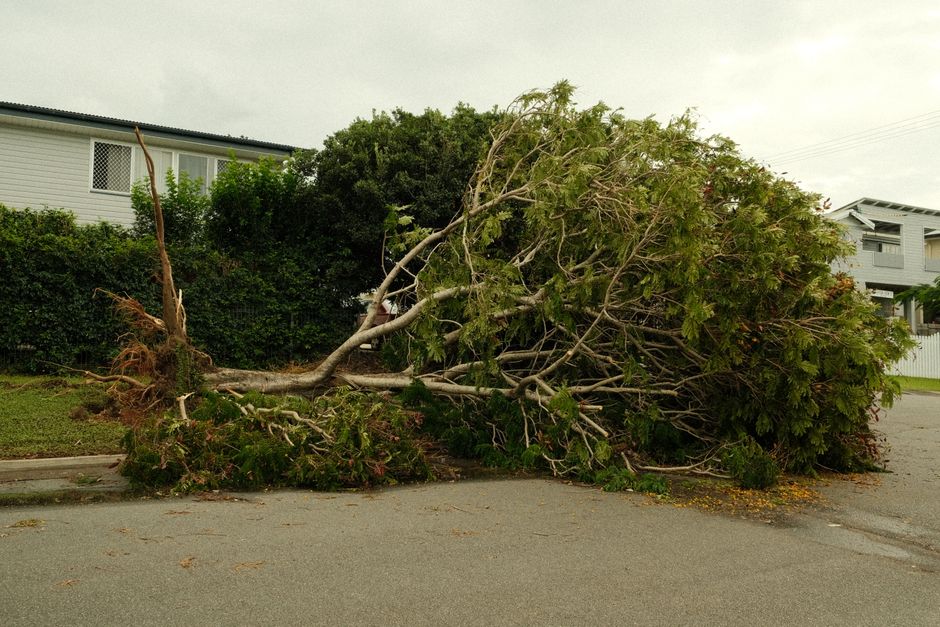
When severe thunderstorms, gale-force winds, or heavy ice sweep through the Ohio River Valley, your yard can change in seconds. Before stepping out with work gloves or tools, take a wide visual scan of the entire property. The immediate aftermath of a severe storm presents unseen physical and electrical dangers that must be addressed methodically.
First and foremost, look up and around for downed utility lines. Always treat any downed wire as fully energized and lethal. Electricity can travel through wet soil, metal fences, and tree sap, creating invisible danger zones. If a fallen limb is contacting a power line or hanging precariously close to electrical infrastructure, keep everyone at least 30 feet away and notify your local utility provider immediately. Tree specialists cannot safely begin work near electrical hazards until the utility company has shut off power and cleared the site.
Beyond electrical risks, standing water can conceal sharp debris, sinkholes, or displaced root systems. Look up into the canopies of surviving trees to check for broken, dangling branches—often called “widow-makers”—that may drop without warning in a light breeze. If you notice split branches caught in the upper crown or a lifted root plate, contact our emergency tree services team right away to secure the area and prevent secondary property damage.
Identifying Urgent Emergencies vs. Non-Hazardous Damage
Post-storm damage naturally falls into two categories: situations that require immediate emergency triage and issues that can safely wait for standard scheduling.
An urgent emergency involves an active threat to life, structural integrity, or critical property access. Examples include:
- A tree or heavy limb resting on your roof, garage, or vehicle.
- A partially uprooted tree leaning sharply toward a occupied structure.
- Large branches blocking your primary driveway, preventing emergency vehicle access.
- Severely fractured trunk unions actively groaning or shifting in the wind.
In these high-stakes scenarios, requesting 247 emergency tree removal ensures rapid containment, structural stabilization, and the prevention of further collapse.
Conversely, non-emergency damage includes scattered small branches across the lawn, broken limbs hanging safely away from structures and walking paths, or a tree that has fallen completely onto open turf without impacting fences, sheds, or driveways. Non-hazardous debris poses no immediate structural risk, meaning you can take time to document the scene, contact your insurance provider, and schedule cleanup during normal operational windows.

Physical Hazards: Spring Poles and Kinetic Tension
One of the most dangerous aspects of post-storm tree work is the presence of stored mechanical energy. When a tree falls or heavy limbs bend beneath the weight of other debris, the wood fibers enter states of extreme compression and tension.
A “spring pole” occurs when a sapling or limb is pinned under a fallen trunk. The wood acts like a drawn bowstring, holding massive kinetic energy. Cutting into tensioned wood without specialized release cuts can cause the branch to violently snap upward or whip sideways, resulting in severe injuries or launching chainsaws back at the operator.
Key kinetic hazards in storm-damaged wood include:
- Spring Poles: Pinned branches or stems ready to release thousands of pounds of upward force upon being cut.
- Barber-Chairing: A vertical trunk splitting upward under tension before the back-cut is complete, snapping unpredictably toward the cutter.
- Roll and Shift Risks: Fallen root plates or logs that roll suddenly when secondary supporting branches are severed.
- Compression Bind: Wood pinching down on a chainsaw bar, trapping equipment and destabilizing the log.
Because these physical forces are unpredictable, leave tensioned stems, root balls, and heavy suspended limbs to professional crews equipped with heavy-duty winches, rigging blocks, and specialized tension-release cutting techniques.
Evaluating Tree Survival: Restoration vs. Complete Removal
Not every tree damaged in a storm needs to be cut down. Trees possess remarkable regenerative capabilities, and many can recover their strength and beauty if structural unions remain sound. Rushing to remove a tree out of initial shock can result in the unnecessary loss of mature canopy shade and property value.
| Canopy Damage Level | Survival Probability | Recommended Action |
|---|---|---|
| Under 25% Loss | High | Clean cut broken stubs; perform light corrective pruning. |
| 25% – 50% Loss | Moderate to High | Prune damaged leaders back to sound lateral branches; monitor health for 2 seasons. |
| 50% – 75% Loss | Species Dependent | Retain if major structural trunk is intact; inspect for internal heartwood decay. |
| Over 75% Loss | Very Low | Removal recommended (except highly resilient species like willow, ash, or poplar). |
When determining can a leaning tree be saved, certified arborists evaluate root plate displacement, trunk integrity, remaining branch structure, and species-specific recovery traits.
Canopy Loss Thresholds and Species Viability
Research into storm recovery demonstrates that most mature hardwood trees can survive 25% to 75% crown damage, although their overall growth rate may slow temporarily while recovering. Hardwoods store substantial carbohydrate reserves in their root systems, allowing them to produce new epicormic shoots along remaining branches to rebuild their canopies.
Pine species exhibit different recovery dynamics. For instance, studies on bent pines reveal that trees bent less than 40° from vertical often straighten naturally within two growing seasons. Pines bent between 40° and 60° may recover with permanent crooks or sweeps in their trunks, while those bent past 60° rarely recover sufficient structural stability and should be removed.
If a hardwood tree retains at least four or five strong lateral limbs and has lost less than half its canopy, monitor it over a two-year recovery window before making permanent removal decisions. However, when defoliation and limb loss exceed sustainable thresholds, determining if a tree dead needs removed prevents lingering decay fungi from spreading throughout your landscape.
Critical Structural Failures Requiring Tree Removal
While minor branch loss is easily managed, certain catastrophic failures compromise a tree beyond repair. If any of the following structural defects are present, schedule professional tree removal services to eliminate the hazard:
- Split Main Trunk or Major Crotch: A vertical split running down the main trunk union indicates the structural core has failed, leaving the remaining halves vulnerable to splitting apart in the next wind event.
- Uprooted or Heaving Root Plate: When the soil around the base of the trunk lifts, tears root networks, or exposes root balls, the tree has lost its anchoring foundation and cannot safely be straightened.
- Extensive Internal Heartwood Decay: Storm wounds that expose large cavities of pre-existing fungal rot or hollow wood indicate the trunk cannot support the remaining crown weight.
- Loss of Primary Top Leader on Brittle Species: When species prone to rot lose their central top stem, the flat break site welcomes wood-boring insects and decay pockets, creating weak re-sprouting points that fail down the road.
The Step-by-Step Guide to Storm Damage Tree Cleanup
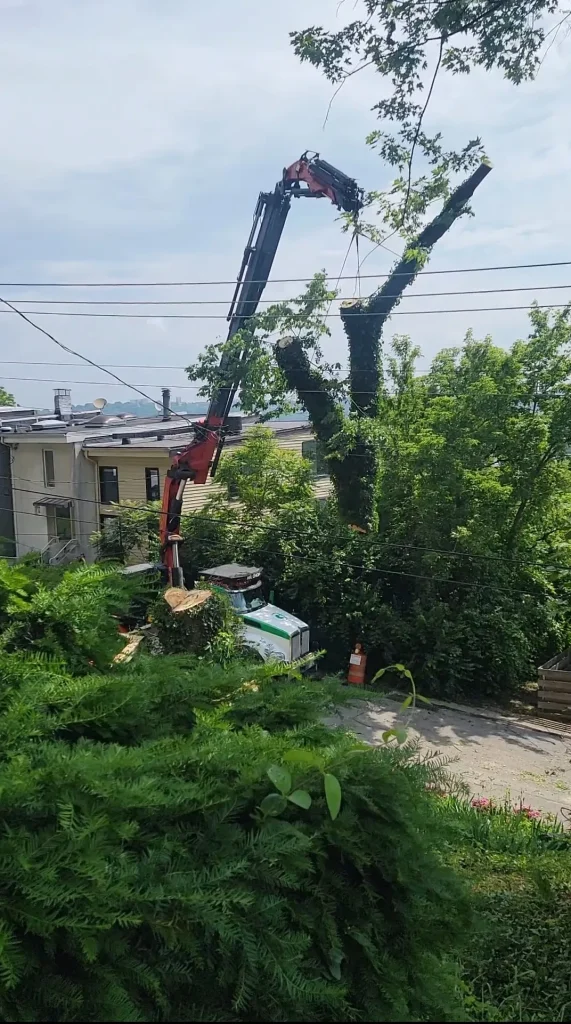
Systematic storm cleanup restores property access and eliminates secondary risks while preserving surviving landscape assets. Executing cleanup safely requires clear task separation between light residential ground work and heavy mechanical dismantling.
Safe DIY Clearing vs. Arborist Intervention
Property owners can safely handle minor surface cleanup provided they wear appropriate Personal Protective Equipment (PPE), including thick work gloves, eye protection, heavy work boots, and a hard hat.
Safe for DIY:
- Gathering, bundling, and dragging small twigs and loose ground branches smaller than 2 inches in diameter.
- Raking scattered leaf and twig debris away from lawn turf and walkways.
- Cutting loose, non-tensioned ground branches that are fully supported across their length using small hand saws or pruners.
Requires Professional Arborists:
- Any cutting involving chainsaws on wood larger than 3 inches in diameter.
- Working on branches suspended higher than chest height.
- Climbing ladders with cutting tools (never use a chainsaw on a ladder).
- Removing limbs resting on houses, vehicles, utility wires, or fences.
- Cutting uprooted root balls, spring poles, or trees caught under heavy physical tension.
What to Expect During Professional Storm Damage Tree Cleanup
When our certified arborists arrive on site for major storm recovery, we follow a rigorous operational process designed to protect structures and hardscaping:
- Safety Perimeter & Structural Triage: We establish clear drop zones and assess surrounding obstacles, including overhead lines, driveways, outbuildings, and neighboring fences.
- Rigged Sectional Dismantling: For trees resting on roofs or trapped in tight yard boundaries, crews utilize sectional tree removal techniques. Using cranes, bucket trucks, and friction-controlled lowering ropes, large logs are suspended, cut, and lowered gently without impacting ground structures.
- Chipping and Haul-Away: Heavy wood chippers process limbs and brush into usable organic mulch, while log-loaders haul heavy trunk wood off-site.
- Stump Grinding Integration: Following tree extraction, choosing stump removal services grinds remaining hazardous stump collars well below grade, eliminating trip hazards and leaving the space ready for fresh turf establishment.
Post-Storm Tree Pruning and Crown Restoration
Surviving trees with broken or torn branches require skilled restorative pruning to prevent disease and structural weakness. Broken stubs should never be left jagged, as torn bark collects water, inviting fungal pathogens and pest infestation.
Professional tree pruning services employ Dr. Alex Shigo’s natural target pruning (the three-cut method) on damaged limbs:
- Cut 1 (Undercut): Made 6 to 12 inches outward from the branch collar on the underside of the limb to prevent falling wood from tearing healthy bark down the trunk.
- Cut 2 (Top Cut): Made slightly farther out from the undercut, relieving branch weight cleanly.
- Cut 3 (Final Collar Cut): A clean, precise cut just outside the branch bark ridge and collar, allowing the tree to naturally form woundwood over the cut site.

Never allow anyone to “top” your damaged trees or apply wound paint and sealants. Tree topping removes vital food-producing buds and forces weak, poorly attached water sprouts that break easily in future storms. Similarly, wound dressings trap internal moisture against the wood, accelerating internal fungal decay rather than preventing it.
Insurance Coverage, Local Regulations, and Contractor Hiring
Managing the logistical and administrative side of storm recovery is just as vital as clearing the wood. Knowing your policy guidelines and local standards protects your finances and prevents post-disaster scams.
Homeowners Insurance Claims for Fallen Trees
Understanding homeowner policy mechanics ensures smooth claim processing after severe weather:
- Structure Damage Is Key: Standard homeowners insurance policies generally cover tree removal expenses only when a fallen tree or limb strikes an insured structure—such as your house, attached garage, detached shed, or perimeter fence.
- Open Lawn Exclusions: If a tree falls entirely across your open lawn, driveway, or garden without striking an insured structure, insurance companies typically will not cover the removal costs, classifying it as routine property maintenance.
- Vehicle Impacts: If a tree falls on your car, the comprehensive coverage portion of your auto insurance policy handles the claim, not your home policy.
- Document Everything: Before clearing or moving any wood, take high-resolution photographs and videos of the damage from multiple angles. Document where the tree broke, the structural damage caused, and any crushed property assets.
For additional details on regional claims handling, consult Local storm damage insurance guidance to navigate adjusters and avoid storm-chasing contractors.
Assessing Costs and Contractor Standards for Storm Damage Tree Cleanup
Disasters often attract unqualified transient contractors who lack proper safety certifications and insurance. To safeguard your property and personal liability, review these 10 things need know hiring tree service before signing contracts:
- General Liability & Workers’ Compensation: Ensure the company carries active policies for both. An exemption certificate is not active workers’ compensation insurance; if an uninsured worker is injured on your property, you could be held liable.
- ISA Certified Arborists: Verify that the crew is led by arborists credentialed through the International Society of Arboriculture (ISA).
- Written, Itemized Estimates: Demand clear documentation detailing debris hauling, wood chipping, stump grinding, and structural extraction.
- No Full Upfront Payments: Reputable tree care providers do not demand cash deposits or full upfront payment before equipment arrives on site.
Proactive Tree Protection: Preventing Severe Storm Hazards
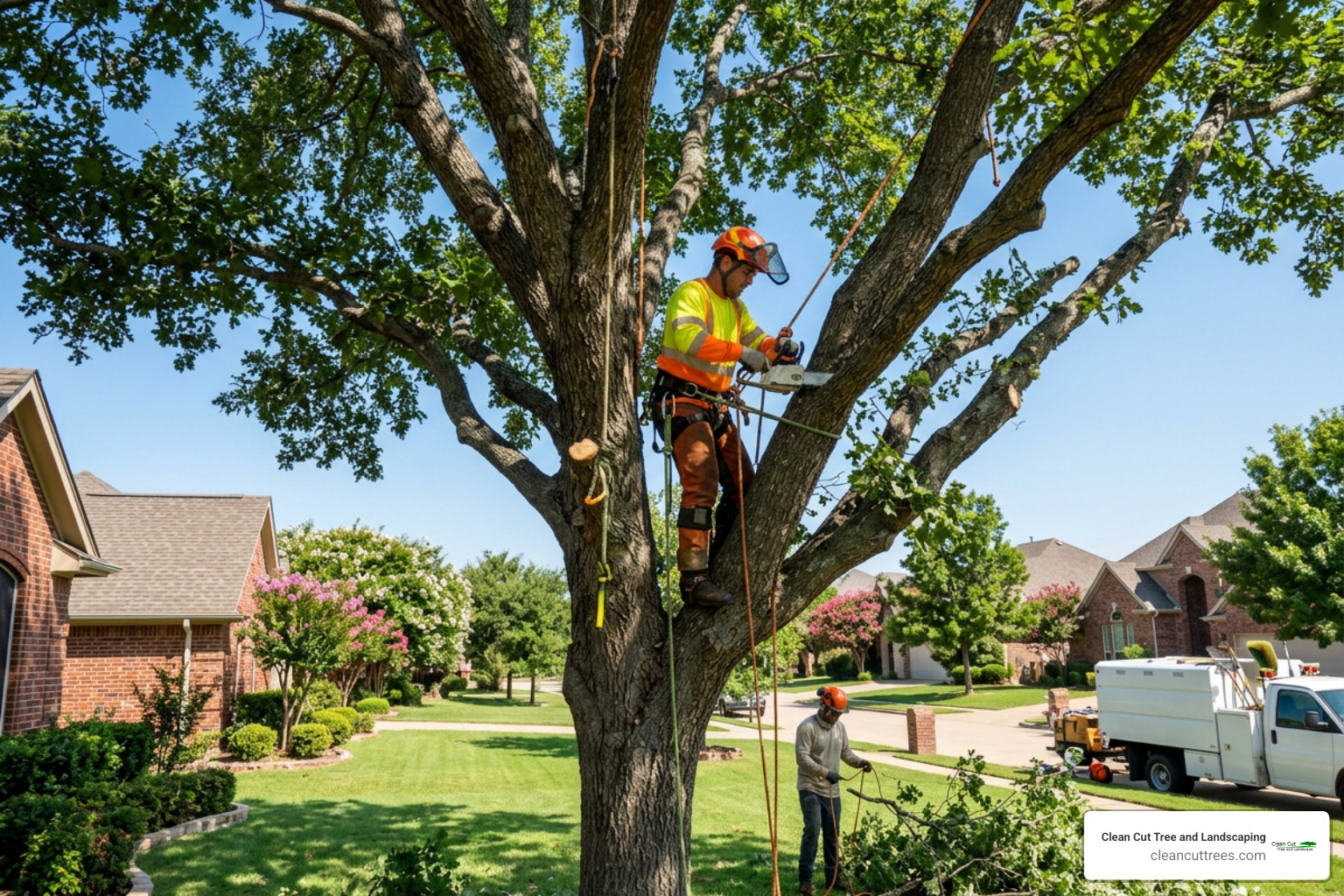
The best time to manage storm damage is long before the clouds gather. Healthy, structurally balanced trees with well-maintained canopies regularly withstand high winds and severe weather that shatter unmanaged trees.
Investing in preparing your trees for summer storms through preventative crown thinning and deadwood removal reduces wind resistance, allowing heavy gusts to pass harmlessly through the canopy like air through a screen rather than catching the crown like a ship’s sail.
Identifying High-Risk Trees and Pre-Storm Weaknesses
Scheduling regular importance of tree inspections in Cincinnati allows certified specialists to identify hidden structural flaws that make trees vulnerable to failure:
- V-Shaped Crotches and Included Bark: Narrow, V-shaped branch unions lack connective wood fibers. As stems grow, bark pinches between them, creating a natural fracture line prone to splitting in high winds.
- Deadwood Accumulation: Dry, brittle deadwood over 2 inches in diameter is easily dislodged during normal thunderstorms, threatening roofs and vehicles below.
- Fungal Conks and Bracket Mushrooms: Mushrooms growing on trunks or surface root collars indicate extensive internal heartwood decay that weakens the tree’s core strength.
- Asymmetrical Canopy Lean: Heavy canopy weight concentrated on one side exerts continuous mechanical torque on root systems, making them vulnerable in waterlogged soils.
Vulnerable Species and Structural Maintenance
Certain tree species commonly planted across our region possess soft, brittle wood or growth habits that make them prone to storm damage:
- Bradford Pear (Pyrus calleryana): Infamous for tight, upright branch unions that reliably split apart under modest wind or ice loads once mature.
- Silver Maple (Acer saccharinum): Fast-growing with weak, brittle wood that drops heavy limbs during summer downpours.
- Dead or Dying Ash Trees (Fraxinus spp.): Widespread Emerald Ash Borer infestations have left thousands of standing dead ash trees throughout the region. Dead ash wood loses its moisture rapidly, becoming exceptionally brittle. Scheduling prompt ash tree removal before dead ash trees collapse is essential for homeowner safety.
Frequently Asked Questions About Post-Storm Tree Recovery
Does homeowner’s insurance cover storm-damaged tree removal if no structure is hit?
Standard homeowners insurance policies rarely cover tree removal when a fallen tree lands solely on an open yard, garden bed, or lawn without damaging an insured structure like a home, garage, shed, or fence. Some policies provide modest coverage (typically up to $500 to $1,000) if the fallen tree completely blocks an active driveway or handicap ramp, preventing vehicle access. Always verify specific coverage terms with your insurance agent.
Can a tree survive if it loses more than 50% of its canopy in a storm?
Yes, depending on the tree species, age, and pre-storm vigor. Many mature hardwoods can survive substantial canopy loss by using stored root energy to push out new epicormic growth. If the trunk is sound and the root plate is fully intact, monitor the tree across a two-year recovery window while performing corrective pruning to remove broken stubs. However, brittle trees, severely decayed specimens, or pines losing over 50% of their crown often decline and may require removal.
What should I do immediately if a tree falls on my roof or vehicle?
First, ensure all family members are safe and evacuate any rooms directly beneath the impact zone. If branches compromised electrical lines, shut off power at the main breaker only if you can access it safely without stepping near wet floors or structural damage. Document the scene with photographs from multiple angles, call your insurance carrier to initiate a claim, and contact a certified tree removal specialist equipped with cranes and rigging equipment to safely stabilize and lift the tree without causing further structural damage.
Conclusion
Recovering from severe storm damage requires patience, safety awareness, and structured decision-making. By keeping a safe distance from downed wires, avoiding dangerous DIY cutting on tensioned limbs, and having certified arborists evaluate damaged trees, you protect your property and family while preserving valuable shade trees whenever possible.
Clean Cut Tree Service provides prompt same day tree removal and hazardous storm recovery throughout Greater Cincinnati. Our certified arborists utilize state-of-the-art cranes, heavy rigging systems, and compact loaders to safely dismantle split, uprooted, or leaning trees in tight, challenging spaces without damaging your home or hardscaping. If a severe storm has damaged trees on your property, explore our professional tree removal service to restore safety and peace of mind today.