
Identifying a Tree Emergency and Immediate Safety Steps
When high winds, heavy rain, or ice storms strike, identifying an active structural threat quickly can prevent minor property damage from escalating into structural collapse. Recognizing structural failure in trees requires understanding the immediate life-safety risks involved. High-pressure storm environments elevate these hazards, making strict adherence to industry safety standards—such as ANSI Z133—essential during initial risk assessments.
What Qualifies as a Tree Emergency?
Not every fallen branch warrants an after-hours emergency call-out. A true tree emergency involves an immediate threat to life, health, or property structure.
Key qualifications for emergency tree response include:
- Structural Impacts: A tree or heavy limb has fallen onto a house, roof, garage, or vehicle.
- Blocked Egress: A fallen trunk or massive branch completely blocks a driveway, front door, or primary access road, trapping residents or preventing emergency vehicle access.
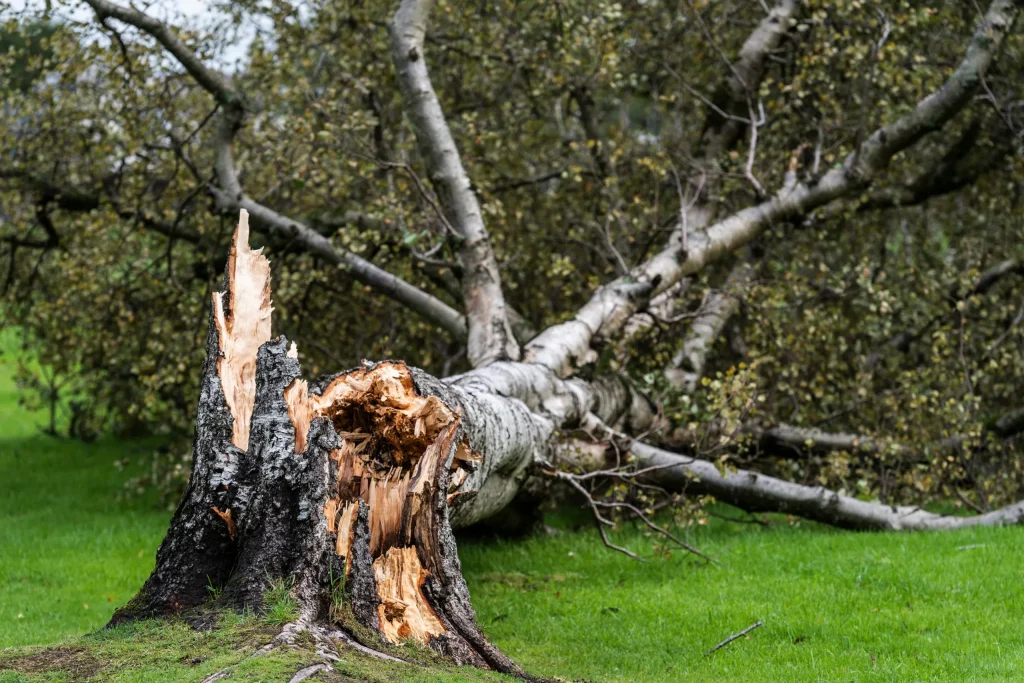
- Imminent Failure Risks: A massive tree has cracked at the trunk, split down the union, or suddenly uprooted and is resting precariously against a building or another tree.
- Severely Compromised Stability: Roots have lifted out of saturated soil, causing an active, visible tilt toward a structure.
If you notice a sudden structural lean after a storm, reading about whether a leaning tree can be saved can help clarify whether immediate emergency extraction or standard scheduled assessment is required.
What to Do Immediately After a Tree Falls
When disaster strikes your property, keeping your family safe is the absolute priority. Follow these immediate safety steps before professional help arrives:
- Evacuate compromised areas: If a heavy trunk or branch impacts your home’s roof or living space, evacuate everyone from that zone or leave the house entirely if the structural integrity is uncertain.
- Maintain a safe distance: Stay away from the root plate of uprooted trees. Soil tension can release unpredictably, causing uprooted root balls to snap back into their original hole without warning.
- Avoid hung-up branches: Never walk underneath broken limbs suspended high in the tree canopy—often called “widow-makers”—as they can drop at any moment.
- Document the damage: Take clear, timestamped photos and videos from a safe distance for insurance documentation.
- Call professional emergency teams: Contact specialized emergency arborists who can mobilize heavy machinery immediately.
Taking early preventative measures, such as preparing your trees for summer storms, significantly reduces the risk of structural failure during severe weather events.
Emergency Safety Protocols Near Power Lines
Trees coming into contact with utility lines represent a high-voltage electrical hazard. High-voltage electricity can arc across open air or travel through damp wood straight into the ground.
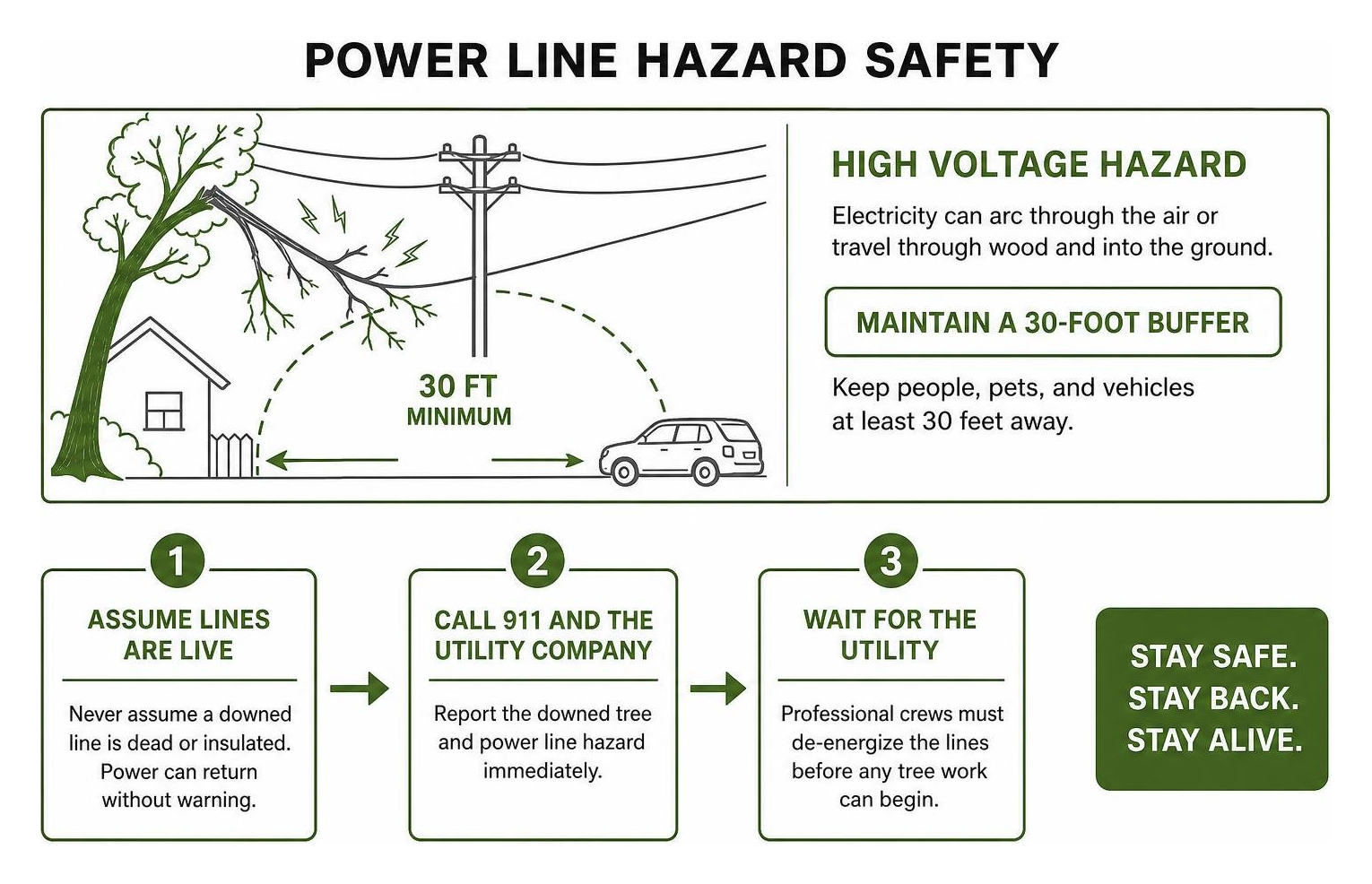
- Maintain a 30-Foot Buffer: Keep all people, pets, and vehicles at least 30 feet away from any tree or limb touching electrical wires.
- Assume Lines Are Live: Never assume a downed line is dead or insulated. Automatic circuit reclosers can re-energize a line unexpectedly.
- Call 911 and the Utility Company First: Professional tree crews cannot begin work near energized lines until the local power company arrives on site, shuts off power, and formally de-energizes the grid segment.
Response Timelines and Steps in the Emergency Removal Process
When you request emergency assistance, certified crews initiate a structured response protocol to secure the area and stabilize your property. Utilizing professional Emergency Tree Services ensures trained crews stabilize high-hazard situations efficiently.
Expected Response Timelines for Emergency Crews
During active storm disasters, emergency response teams operate 24/7/365 to handle urgent calls.
- Triage Dispatch: Calls involving active structural damage, trapped residents, or blocked driveways receive top priority.
- Arrival Windows: Professional emergency providers typically aim to have assessment teams on-site within 1 to 2 hours of an emergency call, even during off-hours or severe weather events.
- Off-Hours Mobilization: Crews remain on standby overnight and on weekends to dispatch bucket trucks, cranes, and specialized rigging equipment the moment an urgent authorization is received.
What to Expect During 24/7 Emergency Tree Removal
Once the emergency team arrives on site, they carry out a systematic four-step mitigation process designed to eliminate hazards without causing secondary damage:
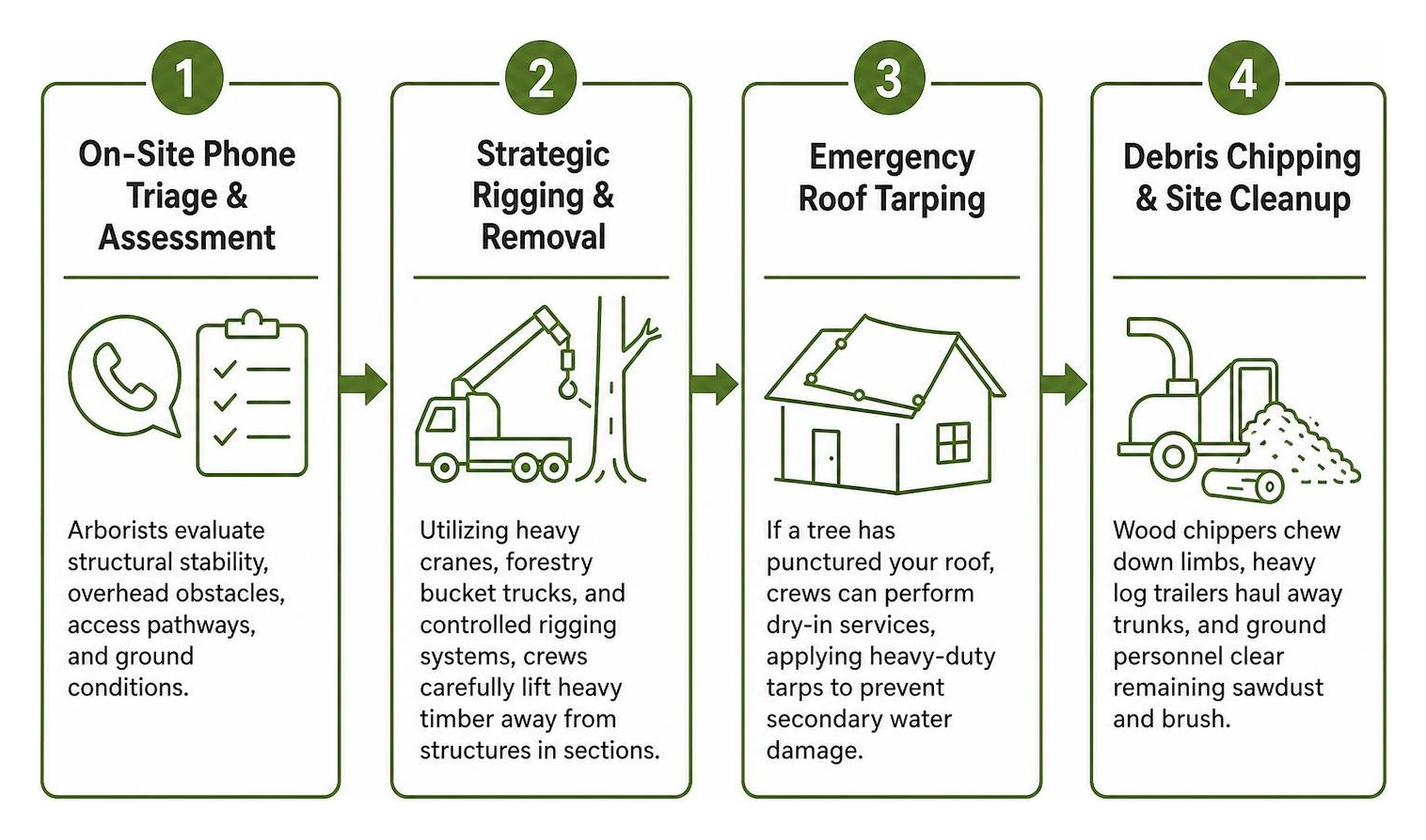
- On-Site Phone Triage & Assessment: Arborists evaluate structural stability, overhead obstacles, access pathways, and ground conditions.
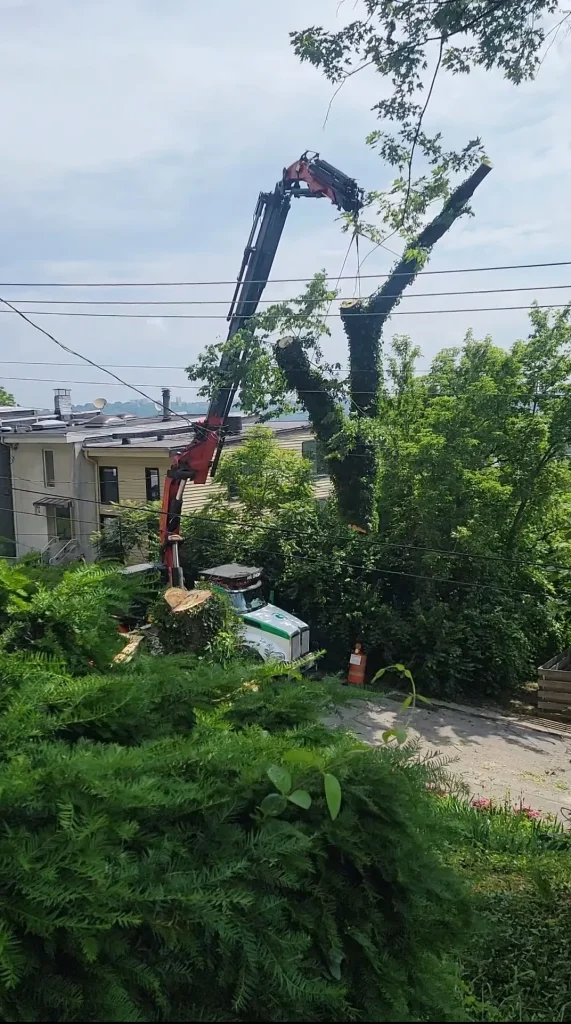
- Strategic Rigging & Removal: Utilizing heavy cranes, forestry bucket trucks, and controlled rigging systems, crews carefully lift heavy timber away from home structures in sections.
- Emergency Roof Tarping: If a tree has punctured your roof, crews can perform dry-in services, applying heavy-duty tarps to prevent secondary water damage from incoming rain.
- Debris Chipping & Site Cleanup: Wood chippers chew down limbs, heavy log trailers haul away trunks, and ground personnel clear remaining sawdust and brush.
For standard non-emergency structural care, you can schedule standard Tree Removal Services to address dead or declining timber before weather strikes.
Handling Specialized Equipment and Tight Access Removal
In dense residential neighborhoods throughout Greater Cincinnati, storm-damaged trees rarely collapse in convenient, wide-open yards. They often fall into narrow side yards, over ornamental gardens, or behind fenced enclosures.
To tackle difficult spatial constraints, specialized equipment is deployed:
- Compact Spider Lifts: Advanced tracked spider lifts can collapse to fit through gates as narrow as 40 inches wide, providing up to 75 feet of aerial reach without crushing yard access points.
- Mini Skid Steers: Operating with a narrow 36-inch clearance, mini skid steers maneuver heavy log sections out of tight backyards smoothly.
- Lawn Protection Protocols: Ground crews lay heavy plywood or specialized synthetic turf mats along access tracks to protect lawns, driveways, and underground irrigation lines from heavy machinery tracks.
24/7 Emergency Tree Removal Costs, Factors, and Insurance Coverage
Emergency operations command higher rates than standard tree maintenance. Understanding price structures and insurance protocols helps property owners manage expenses effectively during storm recovery.
Breakdown of Emergency Tree Removal Costs
In regions like the East Bay and Midwest metro areas, standard baseline emergency removals often start between $800 and $1,500, with complex, multi-crew crane operations exceeding several thousand dollars depending on structural risk.
| Cost Driver | Influence on Total Emergency Invoice |
|---|---|
| Hazard Complexity | High risk (resting on structures, compromised lean) increases safety protocols and labor hours. |
| Tree Size & Weight | Large DBH (diameter at breast height) and massive canopy weight require heavy crane lifting capacity. |
| After-Hours Mobilization | Dispatching crews overnight, on weekends, or during holidays incurs overtime call-out rates. |
| Specialized Equipment | Deployment of heavy cranes, spider lifts, and forestry bucket trucks increases operational overhead. |
| Accessibility Limits | Tight backyard entries requiring manual rigging or narrow-access lifts require added labor time. |
Navigating Homeowners Insurance Claims for Tree Damage
In most storm damage scenarios, your homeowners insurance policy covers emergency tree removal if the tree strikes a covered structure—such as your house, attached garage, or perimeter fence.
- Mitigation Duty: Insurance policies generally require property owners to take reasonable, prompt action to prevent further property damage. You do not need to wait for an adjuster to arrive before hiring a crew to remove an active structural threat.
- Photo Evidence: Take comprehensive, timestamped photos of the damaged structure, tree impact points, and surrounding property line before crews move any wood.
- Aerial Photos for Claims: Arborist crews operating from bucket trucks or cranes can capture detailed overhead photos of roof punctures and canopy damage, providing clear evidence for your adjuster.
- Written Failure Assessments: Professional arborist services provide detailed, itemized invoices along with written tree failure assessments explaining why immediate removal was medically and structurally necessary.
Choosing a Qualified Emergency Tree Service Provider
During severe storms, door-to-door contractors often offer cheap tree cutting. However, hiring uncertified, uninsured operators carries substantial financial and legal liabilities if a secondary structural crash or worker injury occurs on your property.
| Feature / Credential | Certified Emergency Arborist Service | Uncertified Local Contractor |
|---|---|---|
| Arborist Certification | ISA & TRAQ-certified arborist supervision | Uncertified manual laborers |
| Safety Compliance | Strict adherence to ANSI Z133 standards | Casual or non-standard safety protocols |
| Insurance Coverage | Full General Liability & Workman’s Comp | Limited, missing, or zero coverage |
| Tight-Space Access | Compact spider lifts (40″) & mini skid steers | Standard heavy trucks requiring wide entry |
| Insurance Assistance | Overhead photos, failure reports & itemized billing | Hand-written estimates without proof |
Key Qualifications to Look For
Before authorizing any emergency crew to clear timber on your lot, verify these credentials:
- Valid License & Full Insurance: Demand proof of active General Liability insurance and complete Worker’s Compensation coverage to protect yourself against property damage and personal liability claims.
- ISA & TRAQ Certifications: Look for International Society of Arboriculture (ISA) credentials and Tree Risk Assessment Qualification (TRAQ) training, which ensure crew leaders are expert in structural dynamics.
- Specialized Fleet Equipment: Verify that the company owns standard forestry bucket trucks, heavy chippers, compact lifts, and crane partners to execute jobs without multi-day delays.
- Transparent Written Proposals: Even during emergency triage, reputable companies outline clear pricing models, scope of work, and debris disposal policies before commencing non-mitigation work.
How 24/7 Emergency Tree Removal Services Work in Tight Spaces
When a heavy tree collapses into a cramped residential space, cutting the trunk indiscriminately can release stored wood tension, causing log sections to punch through house walls or crush underlying utility pipes.
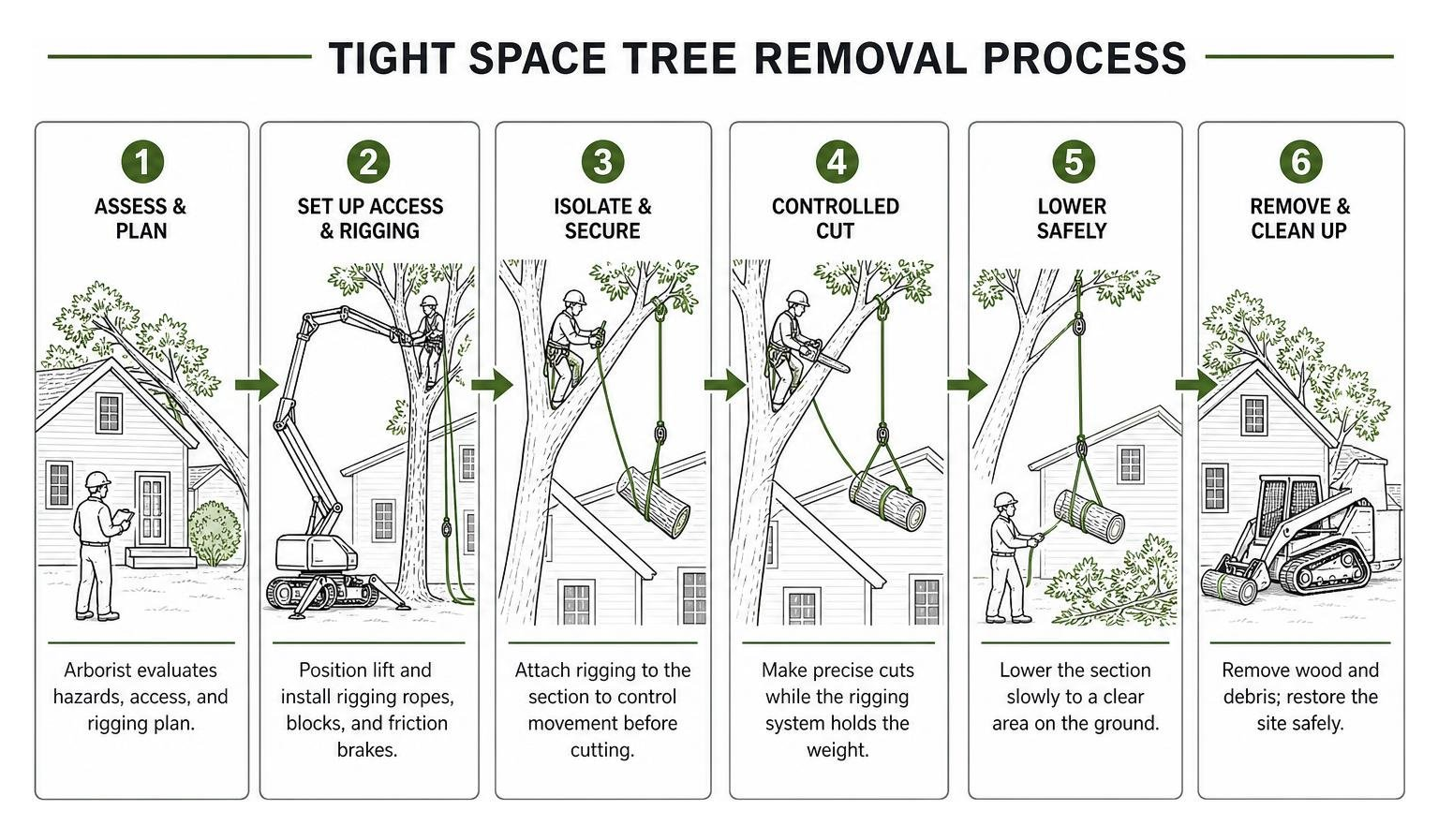
Certified arborists use zero-impact removal techniques:
- Controlled Rigging Systems: Climbers attach heavy-duty friction brakes, blocks, and arborist rigging ropes to secure tree sections before making cuts, lowering wood pieces slowly to the ground.
- Crane-Assisted Extraction: High-capacity cranes reach completely over house rooftops, anchoring onto heavy branches. As the sawyer cuts the limb, the crane lifts the section up and over the house, placing it safely down on the street for processing.
Reviewing proper Tree Removal Safety for the Summer provides valuable insight into the safety protocols professional crews practice during complex extractions.
Frequently Asked Questions About Emergency Tree Removal
Will emergency tree service crews handle full debris cleanup?
Yes, a professional emergency service includes complete debris processing and removal as part of the job. Crews feed brush into industrial chippers, haul log trunks away in dump trailers, sweep sawdust from roofs, driveways, and lawns, and rake the work zone clean.
Should I wait for an insurance adjuster before calling an emergency crew?
No, you should not wait. Homeowners insurance policies expect policyholders to mitigate active hazards immediately to prevent secondary damage (such as rainwater pouring through a structural roof hole). Document the scene thoroughly with photos, call an emergency arborist to remove the structural hazard, and submit the itemized arborist report to your adjuster.
Do I need a municipal permit before emergency tree removal?
In almost all municipalities, emergency permit deferral rules apply. When a tree poses an immediate life-safety hazard or has fallen onto a structure or roadway, you are legally permitted to clear the hazard immediately. Any mandatory local tree removal permits or administrative filings can be completed after the emergency is stabilized.
Conclusion
When severe storms strike Greater Cincinnati, speed, safety, and specialized equipment make all the difference. Clean Cut Tree & Landscaping brings certified arborist expertise, an advanced machinery fleet, and rapid emergency availability to secure your property when disaster hits. From lifting massive trunks off compromised roofs in tight spaces to providing comprehensive photo documentation for insurance claims, we deliver complete peace of mind and leave your property safe and immaculate.
If you face an urgent tree emergency or want to inspect hazardous trees before the next storm arrives, visit our Emergency Tree Services hub or reach out directly on our Contact Us page for fast, reliable support.