
Assessing Risk and Identifying Hazardous Trees Near Your Home
When a massive tree extends its canopy across your shingles, you are living under a biological ticking clock. While mature trees add shade and beauty to your landscape, an unstable tree hanging over a living area poses an incredible threat. Determining whether a tree needs immediate removal or just routine monitoring requires a careful look at structural stability, health indicators, and proximity.
In general, large trees should be at least 20 feet away from a house or building. When a mature specimen grows closer than that—or stretches its primary scaffold limbs directly over your roofline—it demands regular evaluation.
Understanding how trees fail is the first step toward protecting your home. For more insight on how overhanging branches create long-term structural threats, check out our detailed guide on How Overgrown Trees Can Affect Your Roof and Gutters.
Signs You Need Tree Removal Over House Rooflines
Not every overhanging limb requires taking down the whole tree. However, specific physiological warning signs indicate that structural integrity has been compromised. Knowing When to Remove a Tree can prevent catastrophic home repairs.
Keep an eye out for these clear indicators:
- The 50 Percent Rule: As a standard rule of thumb in forestry and arboriculture, if 50 percent or more of the tree is dead, structurally damaged, or severely diseased, the tree should be removed for safety reasons.
- Hollow Trunks and Cavities: Internal rot often eats a tree from the inside out. If a third or more of the tree trunk is rotted or hollow inside, its structural integrity is seriously compromised, making tree removal over house structures an urgent priority.
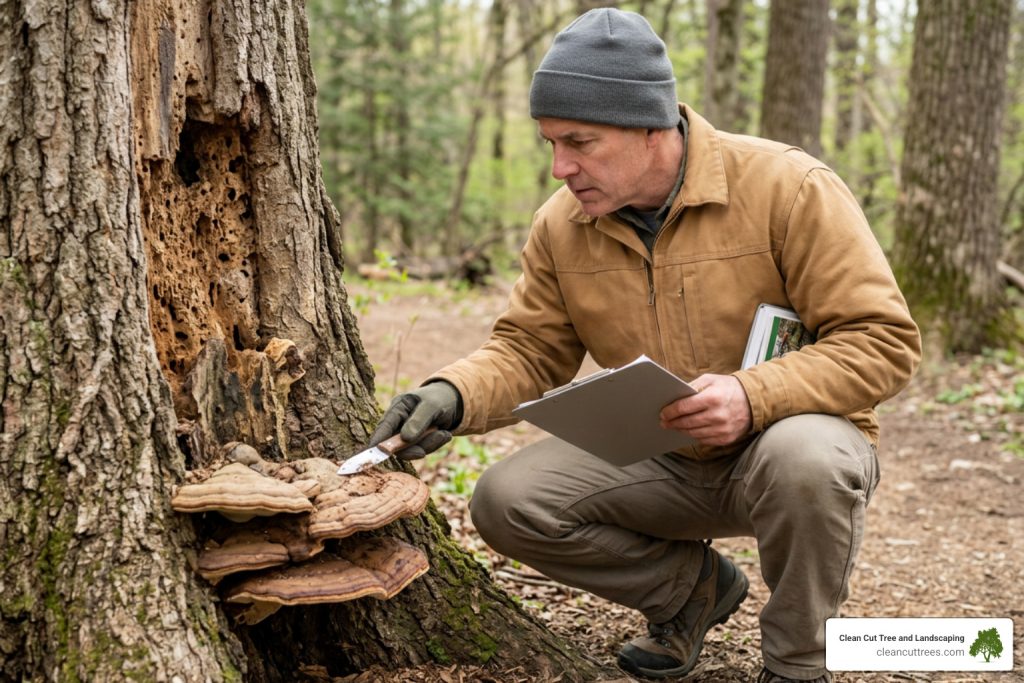
- Fungal Growth and Conks: Mushrooms, bracket fungi, or shelf-like conks sprouting from the trunk or root flare mean wood-decaying fungi are actively digesting the tree’s internal cellulose.
- Epicormic Shoots: When small, leafy sprouts suddenly pop out in clusters along the lower trunk, the tree is under extreme stress and trying desperately to produce foliage because its main canopy is failing.
- Crown Dieback: Major dead limbs at the top of the tree—often called “widow-makers”—can snap off without warning during moderate wind events.
If you are dealing with a tree that has developed an uncomfortable angle toward your home, read our guide on What Greater Cincinnati Homeowners Should Know About Leaning Trees to determine if it can be saved or if it must come down.
Evaluating the Strike Zone and Structural Integrity
Many homeowners assume a tree 50 feet away from their foundation is completely safe. Unfortunately, physics tells a different story.
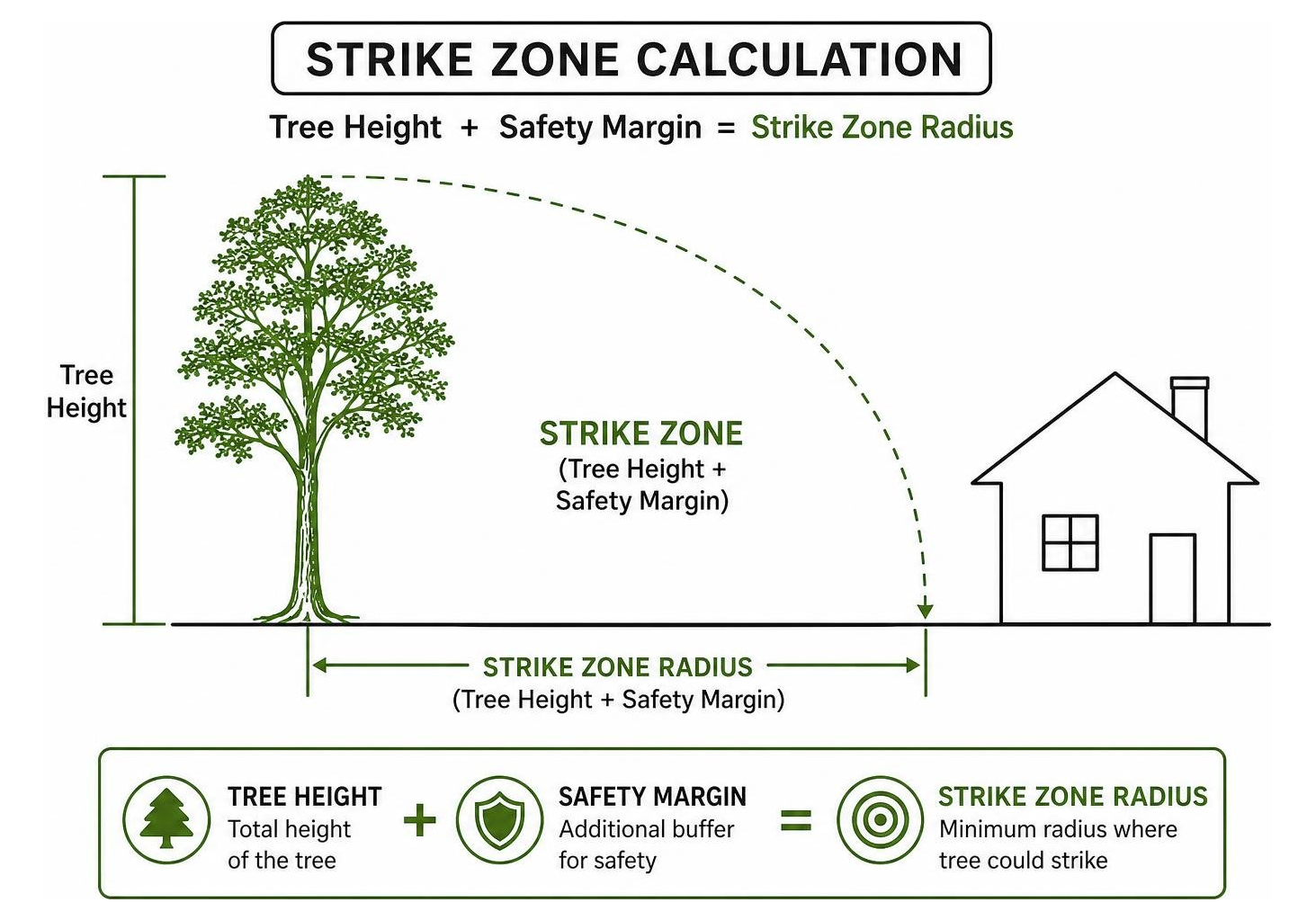
A 70-foot tree commands a minimum 70-foot-plus strike zone radius. Few suburban lots escape this zone entirely. If any portion of a tree’s height can reach a structure upon falling, that structure sits directly in its target arc.
When assessing structural integrity, pay close attention to the ground. Soil heaving, cracked earth, or freshly exposed feeder roots on the side opposite a tree’s lean indicate that the root plate is failing. A tree leaning naturally over time might adjust its wood density, but a sudden or worsening lean combined with root plate movement means the tree could fall at any moment.
Structural Risks and Dangers of Overhanging Trees

Taking down an open-field tree is a simple matter of calculating notch cuts and letting gravity do the heavy lifting. The worst result of a minor calculation error in a field is an extra dent in the turf. Removing a tree over hanging rooflines, however, leaves zero margin for error. There is simply nowhere for a heavy log to go that isn’t a roof, a chimney, a window, or a person.
The mechanics of overhanging trees introduce several distinct physical hazards:
- Stored Tension and Kinetic Energy: A heavy limb extending horizontally over a house acts as a massive cantilevered beam. As wood is cut, stored tension releases suddenly. If a saw operator miscalculates the cut sequence, the branch can kick back, barbershop, or jump unpredictably toward the house.
- Zero Drop Zones: In dense residential neighborhoods, drop zones beneath the tree can be as narrow as 8 feet wide between fences, glass sunrooms, and air conditioning units. Free-dropping wood is impossible.
- Compromised Climbing Anchors: If a tree is dead or rotted, an arborist cannot safely tie off their climbing line to it. Applying weight or dynamic rigging forces to structurally sound-looking limbs on a hollow tree can pull the entire top out.
- Utility Clearances: Overhead power and communication lines frequently slice right through canopy limbs, adding high-voltage electrical shock to an already dangerous jobsite.
Because of these extreme variables, tree work is consistently identified among the most hazardous occupations in America by the USDA Forest Service. Knowing the Top Reasons to Remove a Tree from Your Property before an emergency occurs keeps your property and family out of harm’s way.
Modern Methods for Tree Removal Over House Structures
When space is tight and the stakes are high, professional arborists deploy specialized tactics to dismantle trees piece by piece. Understanding the core methods helps homeowners know what to expect when hiring a Tree Removal Service.
The primary approach for close-quarters tree removal is sectional dismantling. Instead of felling the stem from the base, climbers or lift operators start at the outermost canopy tips and work backward toward the main trunk.
To control every piece of wood cut overhead, crews use friction brakes, heavy-duty rigging lines, block-and-tackle pulleys, and arborist winches. A climber attaches a rigging line to the limb being cut, which runs through a pulley anchored higher in the tree down to a friction-control device (like a Port-a-Wrap) at the base. Once the cut is completed, ground workers lower the heavy branch gently to the lawn, far away from delicate roof structures.
To explore all the ways professional dismantling preserves your property, review the full Benefits of Tree Removal Service.
When Crane Assistance Is Required vs Manual Rigging
While traditional climbing and rigging work well on structural, healthy trees with good drop areas, severe hazards require heavier machinery.

A crane completely changes the physics of tree removal over house structures. In traditional rigging, the tree itself must bear the dynamic weight and impact forces of dropping limbs. With crane-assisted tree removal, the load’s weight is fully supported by the crane boom before the cut is made.
Here is how to know which method your job requires:
- Manual Climbing & Rigging is suitable when: The tree’s wood is structurally sound, reliable tie-in points exist, ground access permits controlled lowering, and limbs can be safely maneuvered around obstacles.
- Crane-Assisted Removal is necessary when: The tree is dead, hollow, or decaying (making it unsafe to climb); the tree is severely leaning or storm-split over a bedroom; there is no usable drop zone on the ground; or the tree’s sheer size makes manual roping too slow or dangerous.
Using a crane allows a crew to lift massive multi-ton canopy sections straight up into the air, clear over the house roofline, and set them down gently in a safe driveway landing zone for chipping.
Step-by-Step Homeowner Preparation and Safety Protocols
Safety during a high-stakes tree removal relies on strong preparation both on the ground and overhead. Reviewing essential Tree Removal Safety protocols ensures your family, property, and the work crew remain safe throughout the process.
Before our heavy trucks or equipment roll up to your curb, taking a few simple steps will streamline the entire project.
Preparing Your Yard and Access Areas Before Crew Arrival
To ensure a smooth, damage-free job, complete this pre-removal checklist the evening before the team arrives:
- Clear the Staging Area: Move all personal items out from under the tree’s canopy. Relocate patio furniture, grills, potted plants, outdoor toys, and yard ornaments well outside the work zone.
- Relocate Vehicles: Park your cars down the street. Leave driveways open for equipment like bucket trucks, chip vans, or heavy cranes.
- Mark Underground Utilities & Structures: Point out irrigation lines, sprinkler heads, outdoor lighting wires, and septic tanks or drain fields. Heavy equipment should never drive over or compact a septic field.
- Secure Pets and Family: Keep dogs and cats indoors for the entire day. The loud noise of chainsaws and chippers can startle animals, and zero unauthorized people should enter the work zone radius.
- Coordinate with Neighbors: If a crane boom must swing over a neighbor’s property boundary, or if rigging gear requires temporary foot access to their lawn, give them advance notice to keep communication clear.
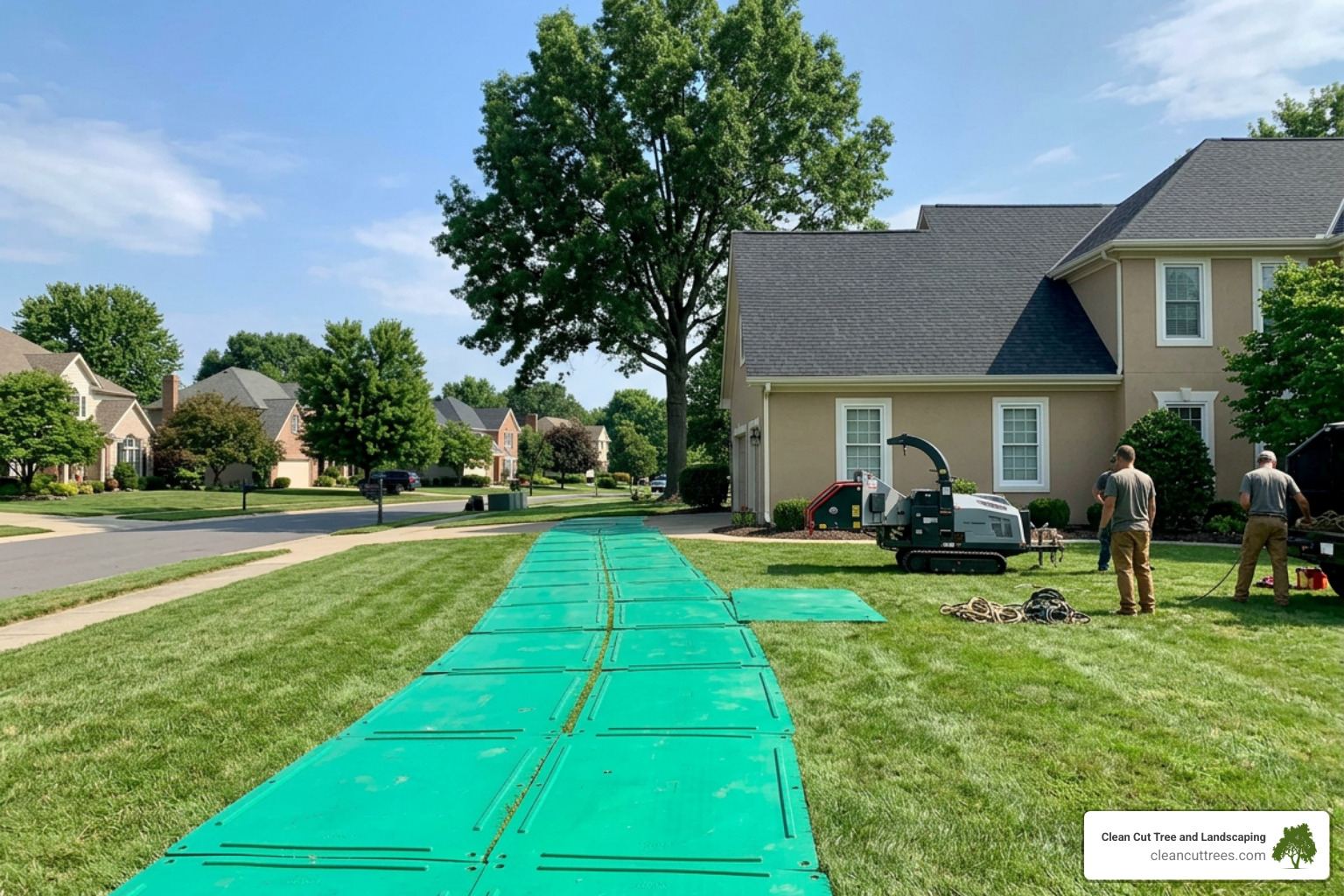
On the day of the job, professional crews will lay down heavy-duty composite turf protection mats along all access paths. These mats distribute heavy machine weight, protecting your lawn from deep ruts and preventing cracked paver driveways or broken underground pipes.
How to Verify Contractor Insurance and Professional Credentials
High-risk tree work over a residence should never be left to uninsured handymen or door-to-door salespersons offering cut-rate prices. Before signing any contract, review these critical credentials outlined in our guide on the 10 Things You Need to Know Before Hiring a Tree Service.
- ISA Certified Arborists: Verify that the company employs arborists certified by the International Society of Arboriculture. This confirms formal training in tree risk assessment, structural physics, and safe ANSI Z133 industry standards.
- Arboriculture-Specific Liability Insurance: Demand a Certificate of Insurance sent directly from the tree service’s insurance agent to your email. Ensure the policy explicitly covers tree care and tree removal—many general contractor policies specifically exclude overhead tree work!
- Workers’ Compensation Insurance: Tree work carries inherent physical risk. If an uninsured worker injures themselves on your roof or in your yard, you as the homeowner could be held liable for their medical expenses and lost wages.
Frequently Asked Questions About Tree Removal Near Structures
Will homeowners insurance cover removing a tree over my house?
Insurance policies distinguish strictly between preventive maintenance and sudden structural damage.
If a healthy or dead tree is simply standing over your house, homeowners insurance will not pay to remove it. Insurance providers view removing a standing tree as routine home maintenance, which is the property owner’s responsibility.
However, if a tree or major branch unexpectedly falls and damages a covered structure (like your roof, garage, or fence) during a storm or wind event, insurance typically covers both the repairs and the cost to extract the tree. If a tree falls in your yard without hitting a structure, policies usually offer little to no removal coverage unless it blocks a primary driveway or handicap ramp.
What are common mistakes during tight-space tree removal?
The most frequent failures during close-quarters tree jobs stem from inadequate equipment or rushing the process:
- Free-Dropping Cuts: Attempting to cut branches without rigging lines, relying on pure luck that the limb won’t bounce off a roof shingle or slice through a gutter.
- Inadequate Drop Zones: Dropping heavy logs onto unprotected lawns, leading to destroyed underground irrigation systems or cracked main water lines.
- Overloading Rigging Anchors: Tying heavy roping blocks to rotted, dead limbs that break under stress and crash through lower rooflines.
- Driving Over Septic Fields: Heavy crane or bucket truck tires can instantly crush subterranean septic tanks and drain pipes if no site plan was made beforehand.
Is crane tree removal more expensive than traditional climbing?
Not necessarily. While bringing a crane onto a job site introduces a machinery mobilization setup cost, it dramatically speeds up the timeline.
A job requiring two full days of laborious, high-risk manual climbing and lowering can often be completed in just 4 to 5 hours with a crane. Shorter working hours mean lower total labor costs, which offsets the equipment rental fee while drastically lowering the overall danger to your home.
Safe, Professional Tree Care for Your Home
Taking down a hazardous tree over a roofline requires precision engineering, specialized equipment, and years of hands-on experience. When limbs are threatening what matters most, don’t leave your property’s safety to chance or uncertified operators.
At Clean Cut Tree & Landscaping, we specialize in rapid emergency response and complex, tight-space removals that other companies turn down. Serving Greater Cincinnati, our team of certified arborists utilizes state-of-the-art rigging systems and crane support to extract hazardous trees safely from virtually impossible spots.
If a leaning or decaying tree is hanging over your roof, contact our team today for a comprehensive risk evaluation and explore our specialized Emergency Tree Services to secure your home.