
Understanding Oversized Stumps and Their Hidden Hazards
What Classifies an Oversized Tree Stump?
In professional arboriculture, an oversized stump is defined as any specimen measuring over 24 inches in diameter across its widest point at ground level. However, estimating the size of a stump based solely on the diameter of the flat top cut is misleading. The true scope of the work lies at the root flare—the wide bell-shaped base where the trunk transitions into the primary anchor roots.
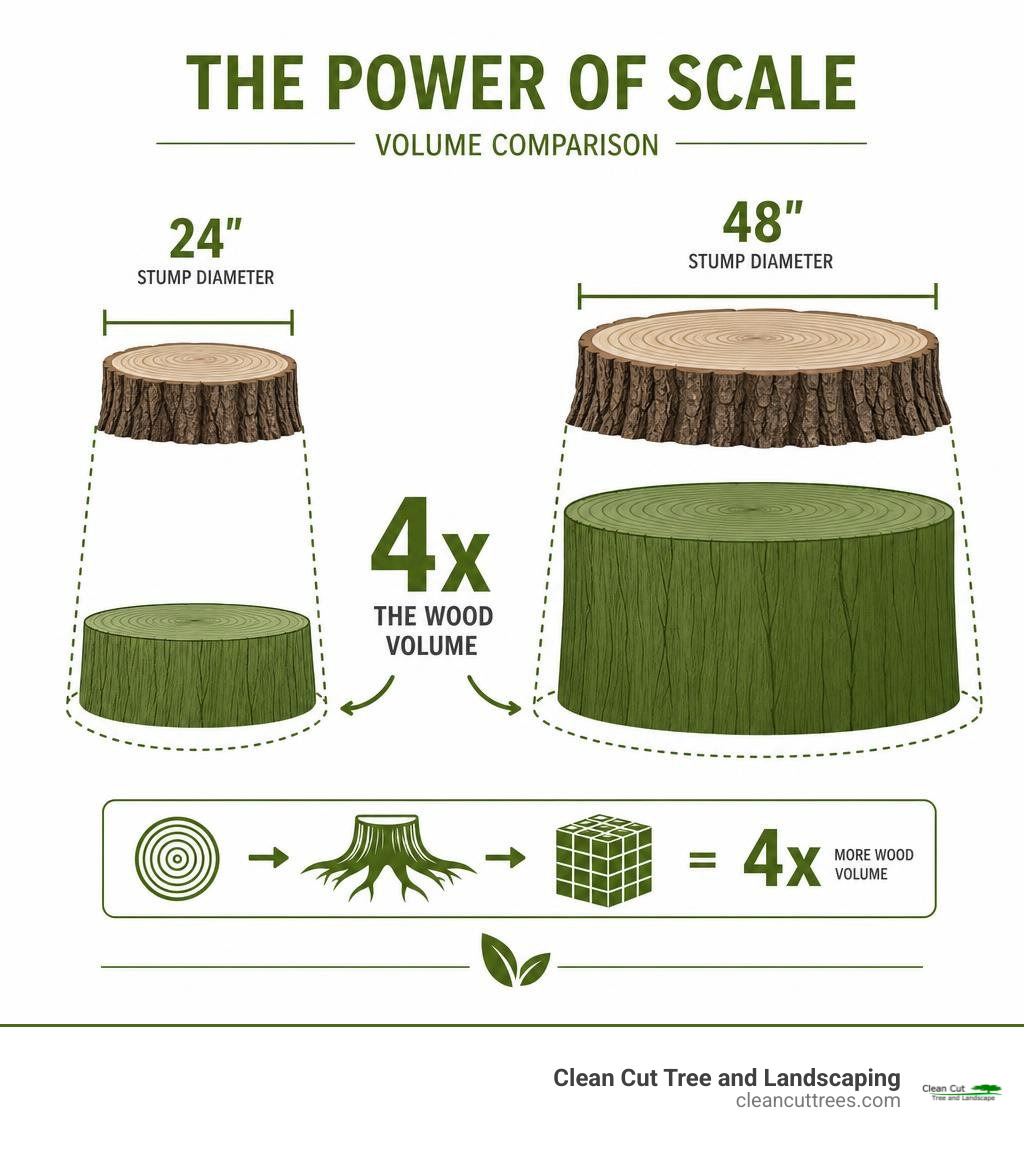
Because volume scales exponentially with diameter, a 48-inch stump contains roughly four times the subterranean wood mass of a 24-inch stump. Mature trees native to Ohio, such as bur oaks, pin oaks, sugar maples, and shagbark hickories, develop dense structural root networks. The root systems of these mature trees often extend 20 to 40 feet in diameter and delve 3 to 5 feet into the ground. Processing this immense volume requires substantial cutting torque and precision root chasing rather than surface skimming. Understanding these subsurface dynamics reveals the clear 5 reasons need remove old stump issues before structural instability or pest infestations develop on your property.
Key Benefits of Professional Large Stump Grinding
Leaving a massive stump to decay on your property creates long-term hazards. As subterranean wood rots, it forms voids beneath the surface that cause ground subsidence, resulting in sunken depressions and severe trip hazards. An untreated hardwood stump also serves as an open invitation for subterranean termites, carpenter ants, and wood-boring beetles that can eventually migrate toward nearby wooden structures.
Beyond safety and pest prevention, oversized stumps damage mowing equipment and prevent property owners from utilizing their outdoor areas. When an old stump is left behind after emergency fellings or storm clearings, booking our comprehensive tree removal services alongside root grinding eliminates liability concerns, prevents mower blade damage, and preserves overall property value.
Heavy Machinery Selection for Oversized Stumps
Commercial Tracked Grinders and Heavy Attachments
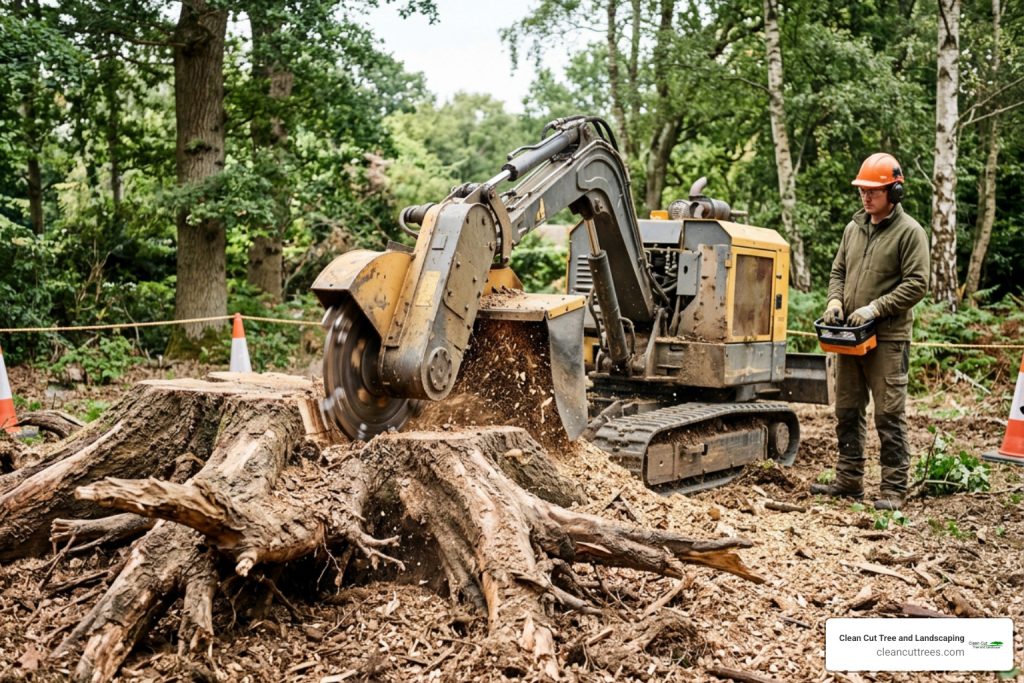
Grinding an oversized hardwood stump requires commercial machinery with high horsepower, heavy cutting wheels, and rugged tungsten carbide cutting teeth. While small rental machines feature lightweight 25-horsepower engines and 16-inch wheels, commercial operations utilize heavy diesel-powered tracked grinders or dedicated hydraulic attachments capable of chewing through dense, green hardwood.
Carbide-tipped teeth are the industry standard because they withstand abrasion from embedded rocks, dense grain, and soil friction. For massive industrial land-clearing projects, contractors may deploy specialized machinery such as heavy-duty excavator stump grinding attachments that drill directly downward with up to 43,000 Nm of torque, or industrial tub grinders for wood processing that process entire uprooted woody root balls into clean mulch.
Navigating Narrow Access and Complex Urban Terrain
One of the greatest challenges in urban and residential settings across Cincinnati is accessing massive stumps located in enclosed backyards, along steep slopes, or behind narrow gates. Commercial tracked stump grinders solve this issue by distributing machine weight evenly across wide rubber tracks, minimizing ground pressure to protect delicate turf from rutting.
With zero-turn maneuverability and hydraulic track retraction, specialized high-horsepower grinders can slip through standard 36-inch backyard gates. When maneuvering over soft ground or along manicured turf, our crews lay down heavy-duty composite ground protection mats. This ensures our high-capacity equipment reaches difficult back-corner locations safely without disturbing your lawn.
The Step-by-Step Large Stump Grinding Process
Pre-Grind Safety, Site Clearing, and Utility Marking
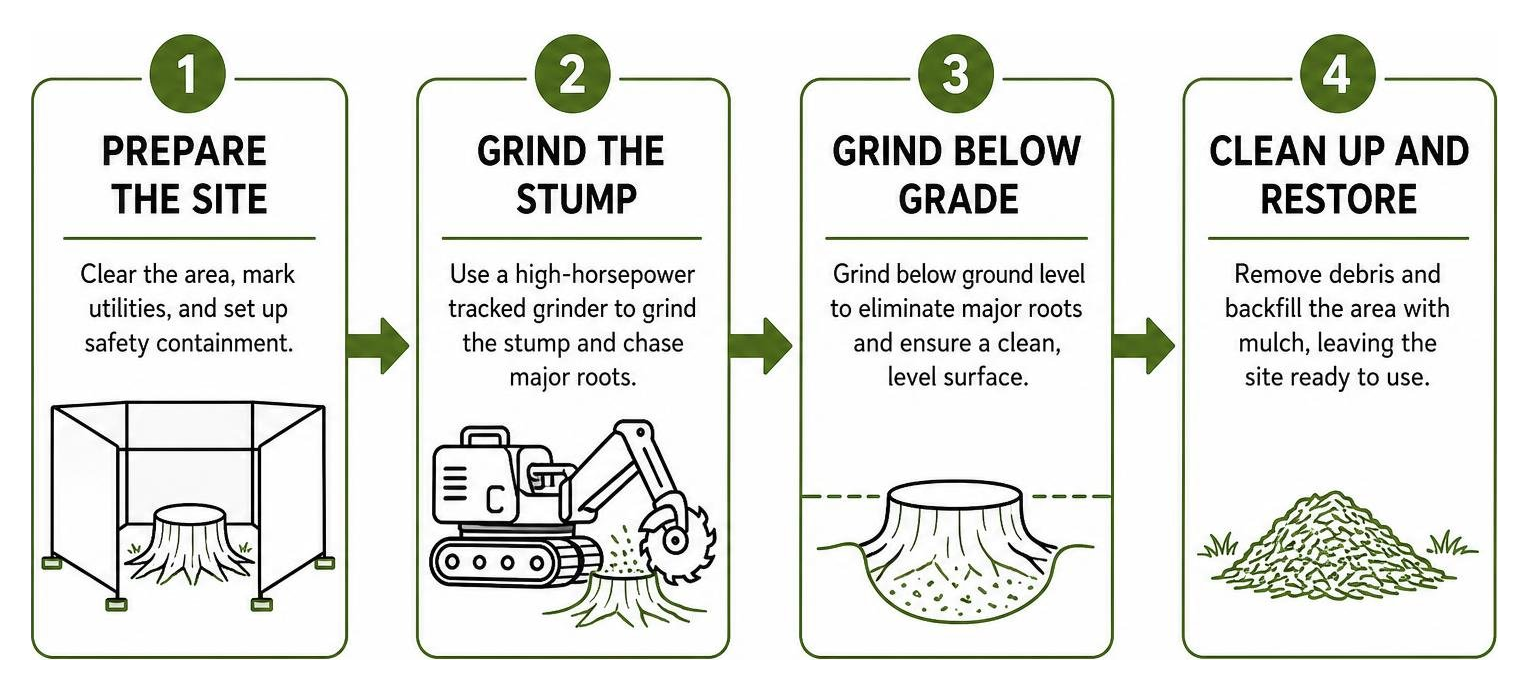
Proper preparation is vital before any cutting wheel touches the wood. The grinding zone must be thoroughly prepped to protect operators, structures, and subterranean infrastructure.
- Utility Locating: Before deep grinding begins, underground public utilities must be marked by calling Ohio811. Private underground utilities, such as invisible dog fences and irrigation lines, should also be flagged.
- Debris Clearing: The base of the trunk and root flare are cleared of rocks, gravel, bricks, and metal debris to prevent dulling cutter teeth and eliminate high-velocity spark hazards.
- Flush Cutting: Using a heavy chainsaw, the stump is cut as flush to the ground as possible to reduce unnecessary grinding time and limit debris dispersion.
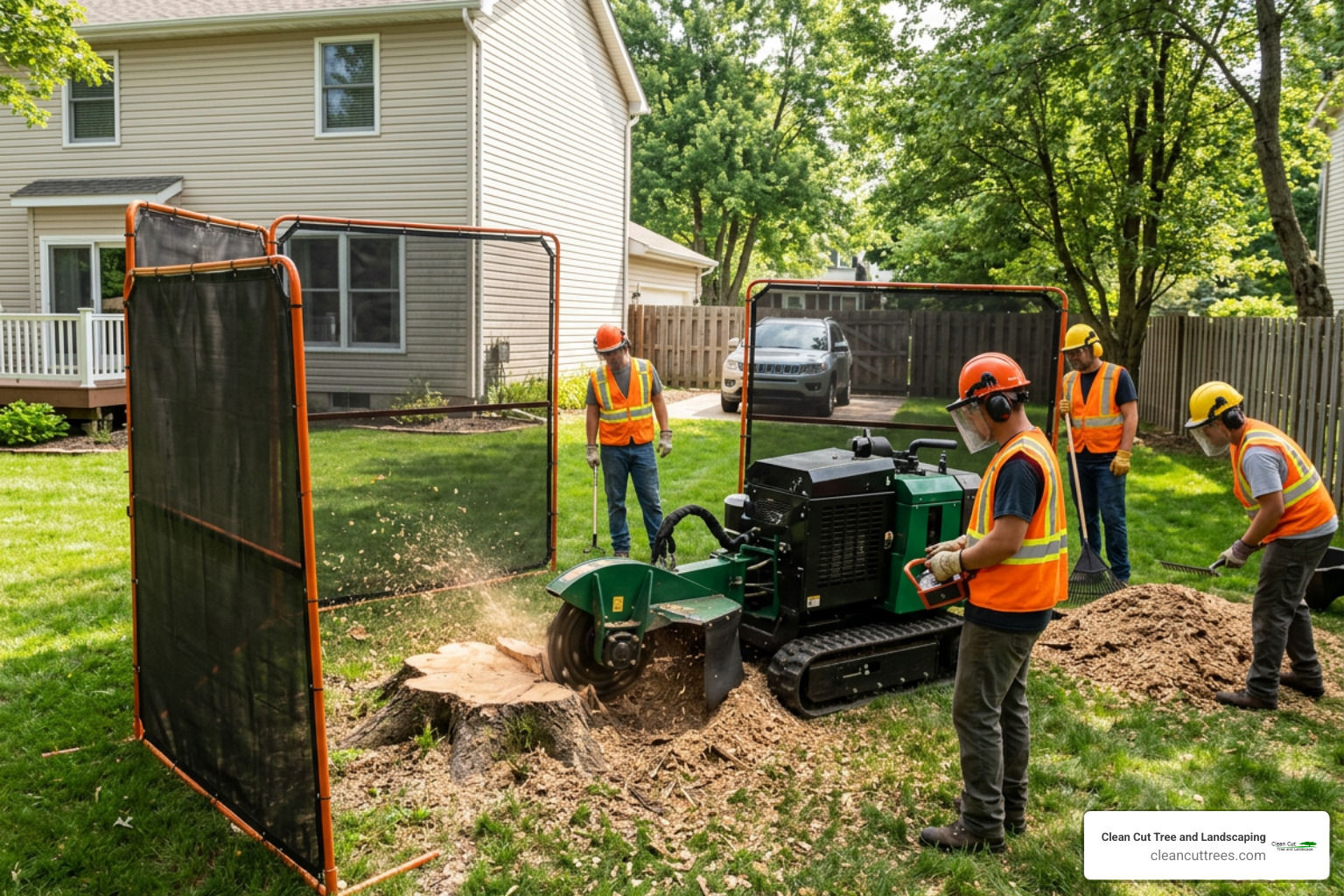
- Safety Containment: Heavy-duty ballistic debris shields, safety curtains, or plywood screens are erected around the work perimeter to stop flying wood fragments from reaching windows, vehicles, or bystanders. Operators wear full personal protective equipment (PPE), including face shields, eye protection, ear defenders, heavy gloves, and steel-toed boots.
Grinding Depth, Root Chasing, and Debris Management
Once containment is secured, the cutting wheel is engaged above the outer edge of the stump. The operator makes sweeping, horizontal passes, lowering the wheel no more than 3 inches per pass to prevent engine bogging and machine stalling.
The process begins on the outer root flares and primary lateral roots, tracing them 10 to 20 feet outward from the trunk base. The machine then methodically chews through the main central core, grinding downward 6 to 12 inches below grade to eliminate the root crown. Grinding in controlled increments ensures that deep-seated taproots are severed. For property owners weighing their clearance options, choosing the best way to remove a stump comes down to achieving this thorough subgrade disruption without destroying the surrounding lawn.
Comparing Stump Grinding to Alternative Removal Methods
Grinding vs. Excavator Extraction and Chemical Treatment
Property owners often wonder whether grinding is superior to physical excavation or chemical acceleration. Each method has distinct operational realities:
| Factor | Mechanical Stump Grinding | Excavator Extraction (Uprooting) | Chemical Acceleration |
|---|---|---|---|
| Site Disturbance | Minimal; confined strictly to the stump and root paths | Severe; leaves massive craters and torn turf | None; zero mechanical impact |
| Time to Completion | 2 to 6 hours for oversized specimens | 1 to 3 hours of heavy machine digging | 12 to 24+ months for wood decay |
| Subterranean Disposal | Processed in place into usable mulch byproduct | Requires hauling heavy root balls to landfills | Decomposes naturally over years |
| Labor & Impact | Controlled, localized work footprint | High collateral damage to surrounding areas | Low labor, but requires manual drilling |
| Effectiveness on Large Trees | High; severs crown and main lateral roots | High; removes total root ball entirely | Low; large hardwoods resist quick rot |
Physical extraction with an excavator tears up large swaths of ground and leaves a massive root ball tangled with rocks and clay, resulting in expensive hauling and disposal fees. Chemical treatments, on the other hand, require drilling holes and waiting years for natural rot to soften dense hardwood. Exploring the different methods of stump removal highlights why mechanical grinding remains the fastest, cleanest, and most practical choice for residential properties.
Factors Affecting Large Stump Grinding Work
Several core variables dictate the overall time, machinery requirements, and logistical approach needed for a large-scale grinding project:
- Stump Diameter and Flare: The total wood volume escalates dramatically as diameter increases across the base.
- Wood Species and Density: Hardwoods like oak, hickory, and beech take 50% to 75% longer to grind than softwoods like pine or spruce, placing more wear on carbide cutting teeth.
- Root System Spread: Surface roots spanning hundreds of square feet require extensive sweeping passes and extra site tracking.
- Site Accessibility: Narrow side yards, tight gates, steep retaining walls, and soft ground require specialized track machines or ground mats.
- Debris Volume: Massive stumps generate cubic yards of wood chips that must be managed, leveled, or hauled away.
When property owners require our specialized stump grinding service, we evaluate these exact physical dimensions to ensure the right high-horsepower machinery is deployed for an efficient, thorough job.
Frequently Asked Questions About Large Stump Removal
How deep should a large tree stump be ground?
For standard turf establishment, grinding 6 to 12 inches below ground level is the industry standard. This depth completely eliminates the root crown, severs primary lateral anchor roots, and prevents sucker regrowth. If the area is slated for construction, foundation pouring, or deep replanting, specialized machinery can grind down 18 to 24+ inches below grade. For additional insights on subgrade depth requirements, review our comprehensive stump removal stump grinding services FAQ.
Can large stump grinding eliminate aggressive species regrowth?
Yes, for the vast majority of tree species, mechanical grinding permanently eliminates regrowth by obliterating the root crown where regenerative buds reside. However, certain aggressive species (such as Tree of Heaven, black locust, or sumac) can sprout shoots from distant lateral root fragments left deep underground. In these rare instances, targeted non-chemical physical removal of secondary shoots ensures complete control.
How much wood chip debris does a large stump produce?
Due to expansion volume when solid wood is shaved into chips, a large stump typically produces between 3 and 8 cubic yards of mulch. This volume is more than enough to backfill the cavity created during grinding. The remaining wood chips can be raked flush, redistributed as mulch around tree rings and planting beds, or hauled away if you prefer a cleared surface.
Conclusion
Managing oversized tree stumps across Greater Cincinnati requires heavy-duty machinery, rigorous safety protocols, and certified arborist expertise. Leaving massive stumps to rot invites pest infestations, creates liability hazards, and wastes valuable yard space. Our specialized, high-horsepower tracked grinders allow us to navigate tight urban spaces and safely remove even the most stubborn hardwood stumps and root flares.
At Clean Cut Tree, our certified arborists specialize in rapid emergency response, same day tree removal, and navigating difficult or “nearly impossible” tight-access spaces with top-tier equipment. Whether you need a massive heritage oak root flare ground down or hazardous storm-damaged trunks cleared, rely on our team for complete property clearance. Explore our professional stump removal services today to restore the safety and beauty of your property.