
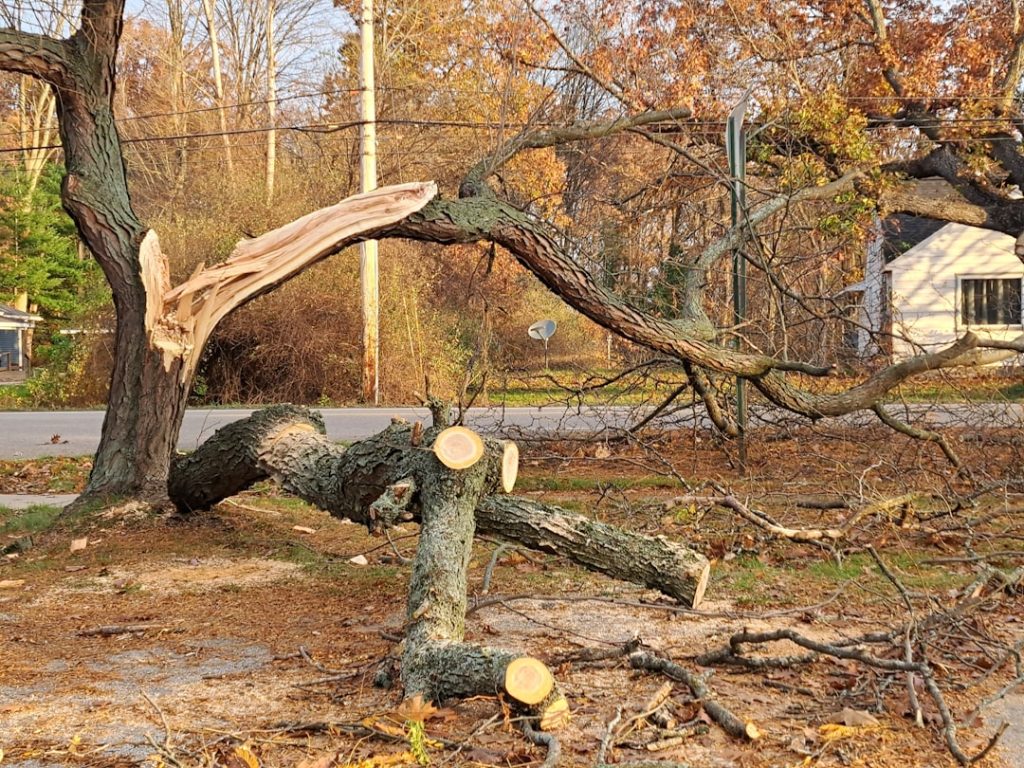
Post-Storm Hazard Tree Identification: Spot the Urgent Warning Signs
Hazard tree identification means looking for a damaged, diseased, or unstable tree – or tree part – that could fail and strike a person, home, vehicle, utility line, or other nearby target.
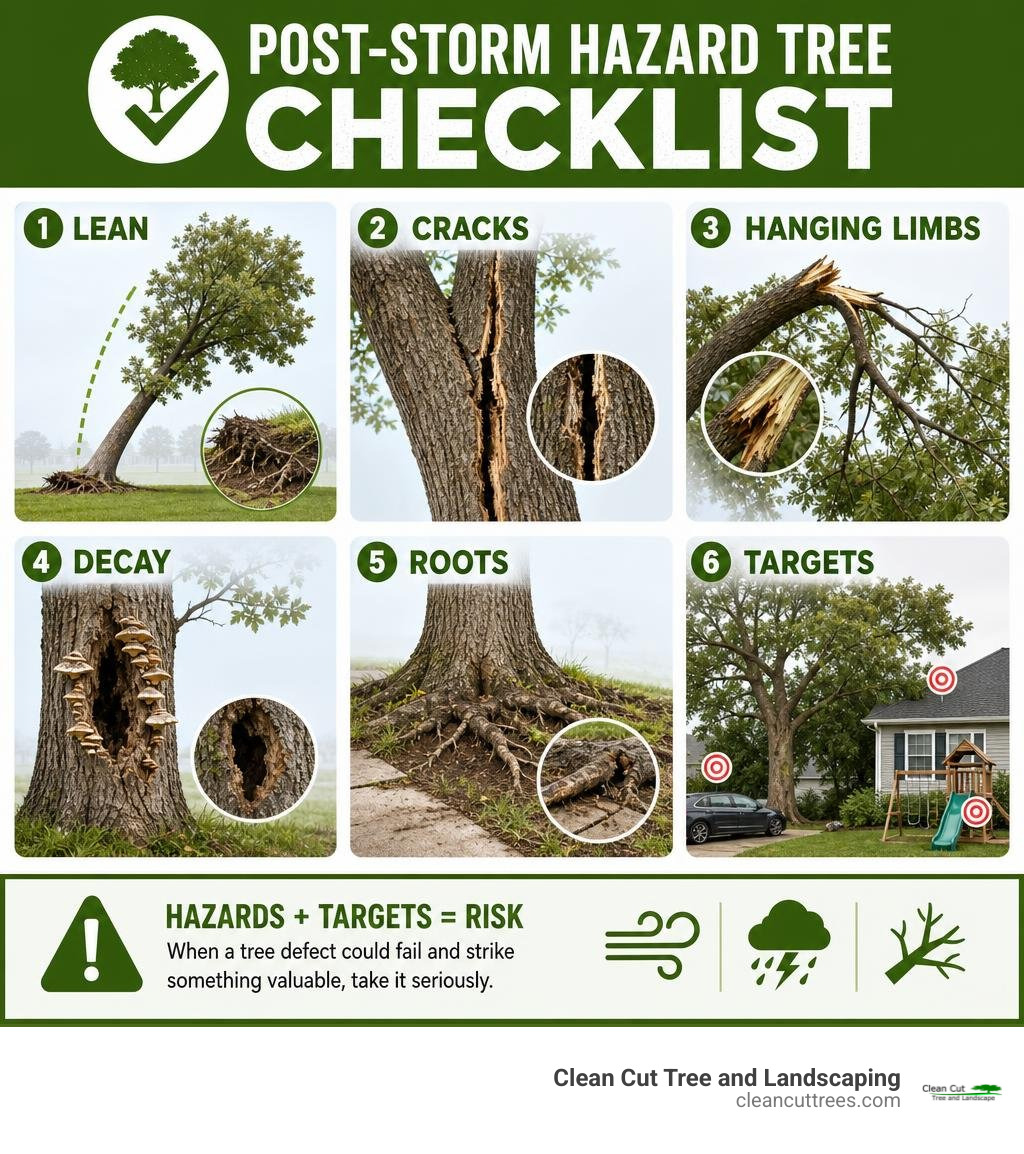
After a Greater Cincinnati storm, treat these signs as urgent:
- A new lean, lifted roots, or cracked/heaving soil near the trunk base.
- Split trunks, fresh deep cracks, or a broken top.
- Large hanging or broken limbs caught in the canopy, often called “widow makers.”
- Mushrooms or fungal growth at the base, cavities, loose bark, or obvious decay.
- A tree or limb touching power lines, blocking access, or hanging over a home, driveway, or play area.
A defect alone does not always make a tree hazardous. Risk rises when the tree has a real chance of failure and something valuable is within its potential impact zone. A dead limb in a remote wooded area is different from that same limb over a parked car or a child’s swing set.
Do not walk, park, work, or let children play beneath a tree with fresh storm damage. Keep clear of downed wires and contact the utility company for electrical hazards. For unstable trees or overhead limbs, a qualified tree professional should assess the site before anyone attempts cleanup.
Fundamentals of Hazard Tree Identification and Risk Rating Systems
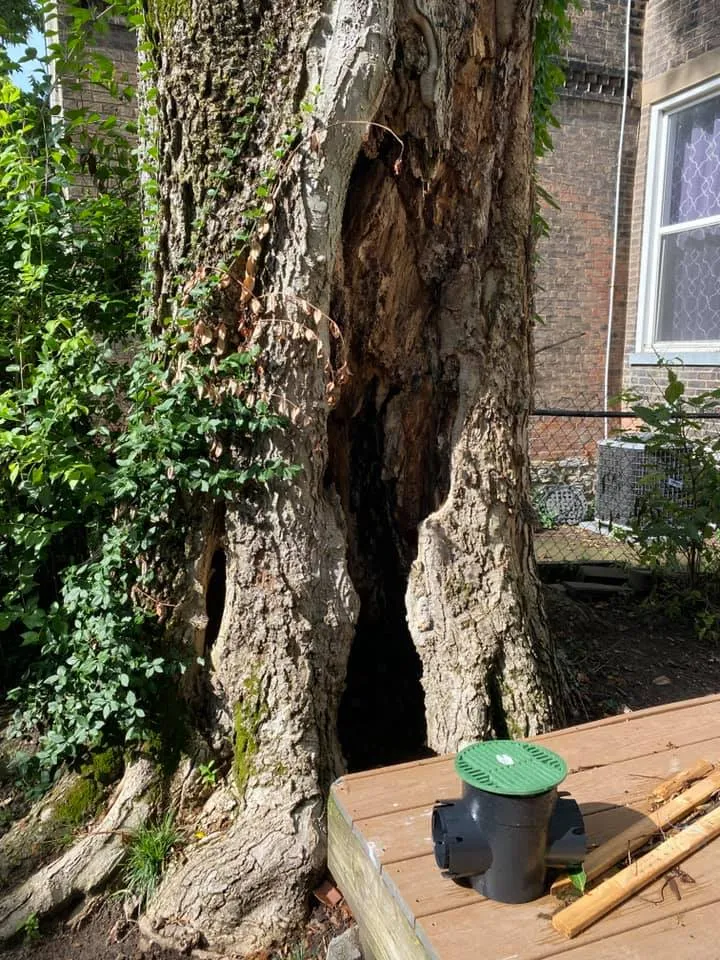
Understanding how arborists evaluate tree risk starts with a fundamental truth: trees are living structures subjected to massive physics loads. Every gust of wind, heavy snowfall, and summer cloudburst places mechanical stress on a tree’s root system, trunk, and branch architecture. On a long enough timeline, every tree will naturally degrade—but when structural weaknesses intersect with human activity, routine biology becomes an urgent safety issue.
Proper hazard tree identification relies on systematic evaluation rather than guesswork. When we inspect a tree on a Greater Cincinnati property, we don’t just ask, “Does this tree look bad?” We examine the complex relationship between structural wood integrity, environmental stress, and nearby targets.
Core Components of Hazard Tree Identification
In professional forestry and arboriculture, a tree is not legally or practically categorized as a hazard simply because it possesses a decay pocket or a dead branch. A true tree hazard requires a three-component framework:
- Structural Defect: A physical flaw, disease, or structural weakness (such as internal rot, deep trunk cracks, or a compromised root plate) that increases the likelihood of structural failure.
- Failure Potential: The numerical or qualitative probability that the whole tree, or a specific part of it, will collapse or break away within a given timeframe.
- Target Presence: A person, building, vehicle, sidewalk, playground, or utility infrastructure located within striking distance of the failing tree component.
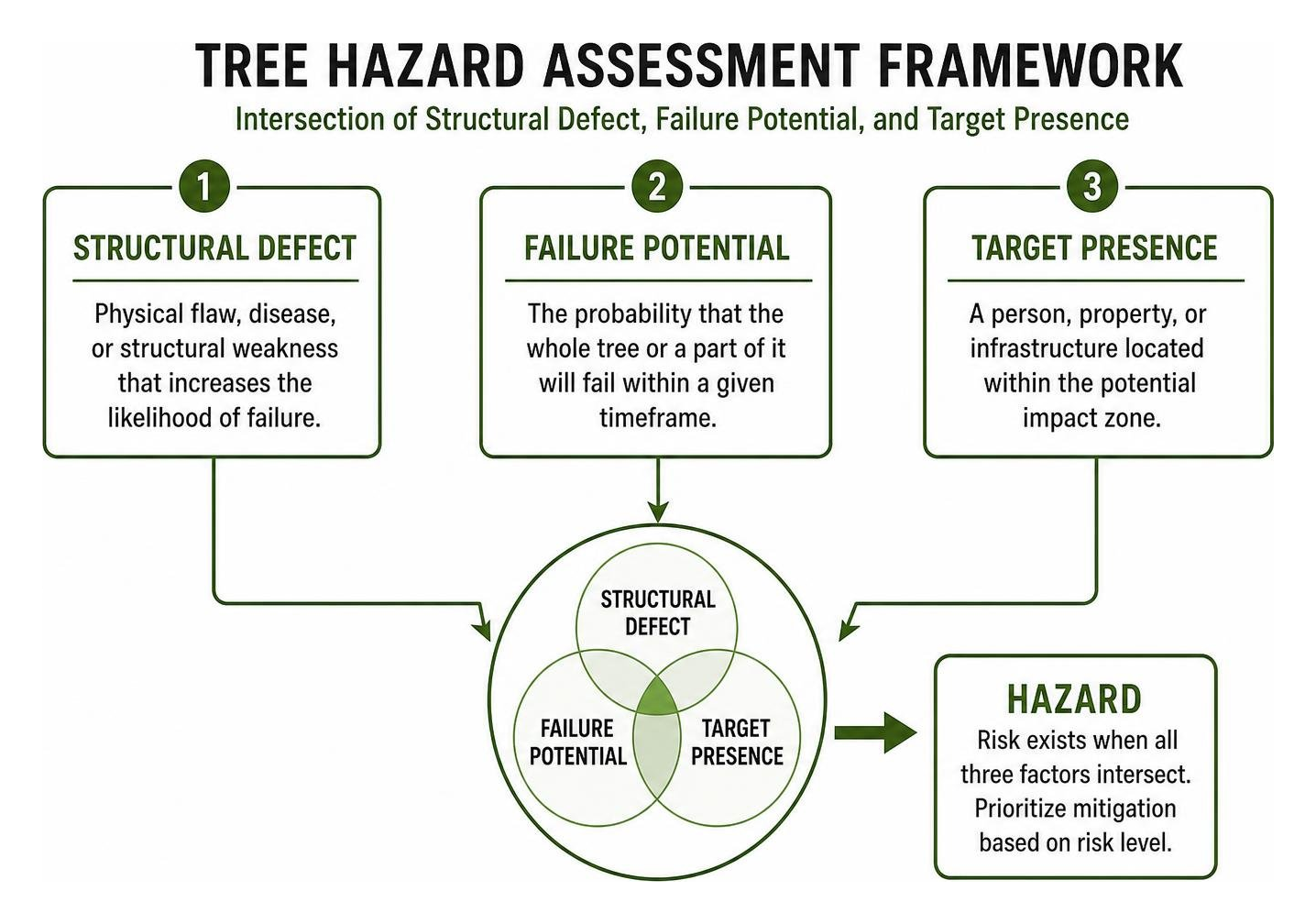
Without a target, a defective tree in the deep forest is just a natural snag providing habitat for wildlife. But put that exact same defective tree next to your driveway, and it transforms into an immediate hazard.
Target evaluation also factors in exposure duration. A picnic table where family members sit for hours every weekend represents a higher continuous exposure target than a decorative garden gnome. As detailed in the USFS Guide to Hazard Tree Assessment, quantitative hazard rating systems assign numerical scores (typically combining failure potential, damage potential, and target occupancy) to create an overall risk score between 3 and 10. This allows land managers and home owners to objectively prioritize high-risk removals over lower-priority maintenance.
ISA Risk Assessment Levels: Level 1 to Level 3
The International Society of Arboriculture (ISA) standardizes tree risk evaluation into three distinct operational levels. Knowing which level your property needs ensures you get accurate diagnostic results without unnecessary expense.
- Level 1: Limited Visual Assessment: This is a high-level screening, often called a “drive-by” or quick walk-through inspection. Level 1 assessments look for obvious macro-hazards across large populations of trees—such as completely dead canopy tops, severe storm-induced leans, or shattered main limbs hanging over roadways. Municipalities frequently use Level 1 assessments to screen thousands of roadside shade trees efficiently.
- Level 2: Basic Assessment: This is the standard 360-degree ground-level inspection performed by a certified professional. During a Level 2 evaluation, we walk entirely around the tree, inspecting the root crown, trunk, main branch scaffold, and outer canopy. We utilize simple, non-destructive tools like a rubber sounding mallet to check for internal hollows, a soil probe to check for root plate lifting, and binoculars to inspect upper branch unions. Level 2 is the standard evaluation recommended for residential properties. For home owners in our area, learning about the Importance of Tree Inspections in Cincinnati can help prevent sudden property damage before severe weather rolls through.
- Level 3: Advanced Assessment: When a high-value or historic tree exhibits subtle visual indicators of deep structural rot during a Level 2 check, a Level 3 assessment is triggered. This tier involves advanced diagnostic technology, such as micro-drilling with a resistograph to measure wood density, sonic tomography to produce a digital cross-section of internal trunk sound wood, aerial canopy inspections by climbing arborists, or root crown excavation using high-pressure air tools.
Warning Signs and Structural Defects After Severe Weather

Severe weather acts as an uncompromising stress test for trees. High wind gusts, heavy summer downpours that saturate soils, and winter ice accumulations frequently expose structural weaknesses that were previously hidden beneath lush foliage.
Crown, Branch, and Trunk Vulnerabilities in Conifers vs. Hardwoods
Different tree species respond to severe weather in distinctly different ways. Understanding how hardwoods (like oaks, maples, and ashes) differ from conifers (such as pines, hemlocks, and spruces) is crucial during post-storm inspections.
Hardwood Vulnerabilities
Hardwoods are particularly susceptible to weak branch unions with included bark. When two codominant stems grow upward in a tight “V” shape rather than a wide “U” shape, bark becomes trapped inside the junction as the stems expand. This trapped bark acts like a wedge, preventing the wood fibers from fusing together. Under heavy winds or winter snow loading, these V-unions split wide open, tearing down massive sections of the trunk. Furthermore, hardwoods are prone to large dead limbs—famously called “widow makers”—that break off in high winds and become suspended in the upper canopy, waiting for a light breeze to drop them onto whatever sits below.
Conifer Vulnerabilities
Conifers tend to possess a single central leader, giving them better wind resistance, but they face unique fungal and structural liabilities. Conifers frequently suffer from heavy mistletoe infections that cause witches’ brooms—dense, congested clusters of branches. A single witches’ broom limb can weigh over 200 pounds! This massive, unbalancing weight distribution creates extreme leverage that easily snaps large conifer branches during winter storms.
When inspecting conifers for internal rot, arborists look for resinosis (excessive, white-to-amber sap flow oozing from the trunk or butt response wounds) and fungal fruiting bodies known as conks. Conks growing directly on the bark or root collar indicate that internal decay fungi (such as Phaeolus schweinitzii or Armillaria root rot) are actively consuming the structural lignin and cellulose inside the tree.
For additional seasonal tips, check our guides on Preparing Your Trees for Summer Storms and discovering How to Spot and Address Winter Tree Damage Before It’s Too Late.
Calculating Potential Impact Zones and Severe Lean Hazards
One of the most dangerous defects exposed by severe weather is a sudden trunk lean accompanied by root plate movement. However, homeowners often ask: how far reaching is the danger zone if a tree actually collapses?
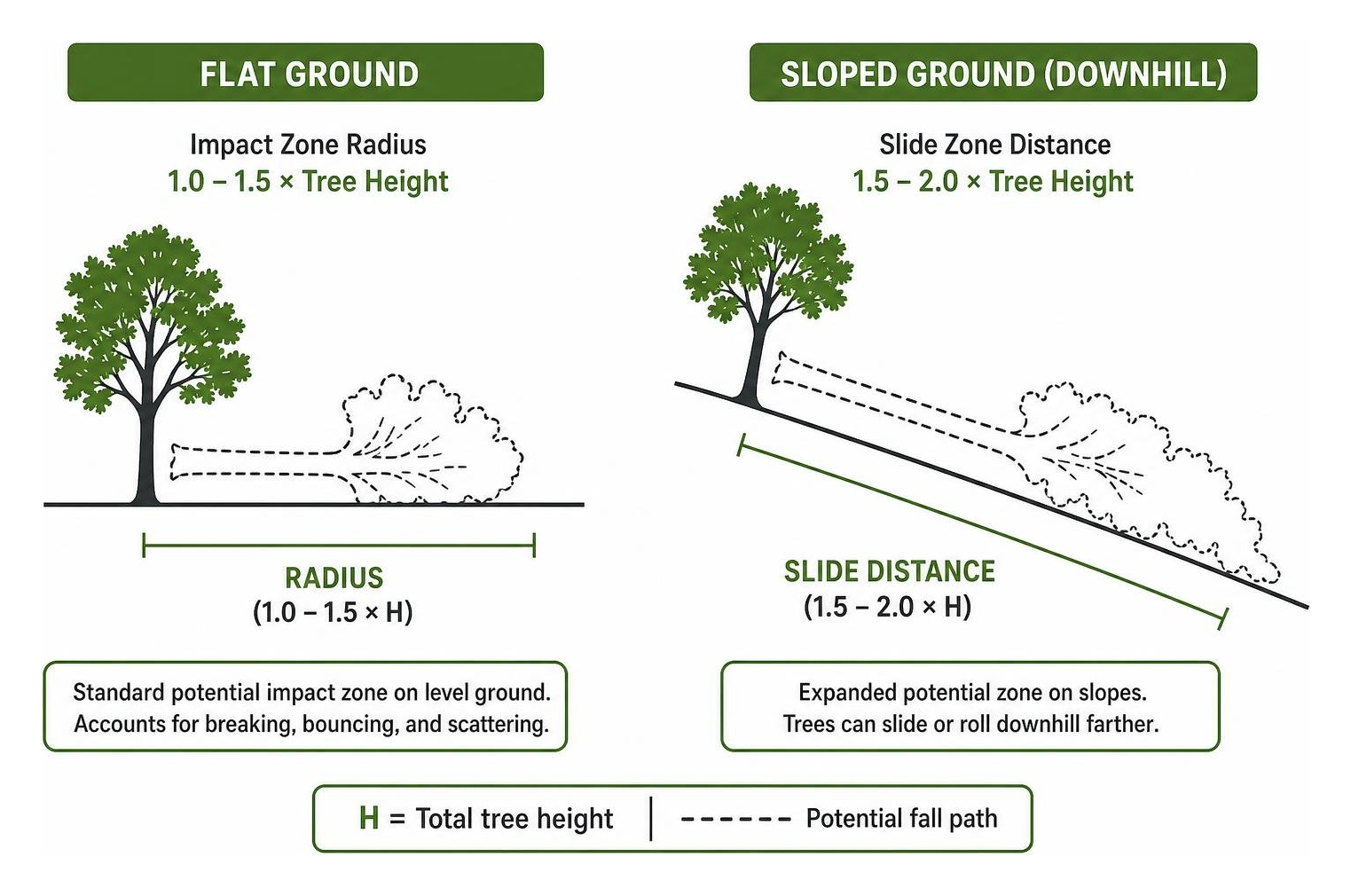
The Potential Impact Zone (PIZ)
On flat ground, a tree’s standard potential failure zone is calculated as 1.0 to 1.5 times the total height of the tree (or the length of the failing branch part). This extra buffer accounts for shattered limbs bouncing, sliding, or scattering upon impact.
However, if your property features sloped terrain, the potential impact zone must be expanded downhill. On steep hillsides, falling trees act like sleds—sliding and rolling up to 1.5 to 2.0 times their total height down the slope.
Assessing Tree Lean Hazards
Not all leaning trees are immediate emergencies. A tree that grew with a natural, slow sweep toward light over decades often forms reaction wood—producing extra thick rings to reinforce its structural center of gravity. You can spot a safe, natural lean by looking at the top of the tree: if the upper leader has corrected itself by curving straight up toward the sky, the tree has successfully balanced its weight over time.
Conversely, a sudden, uncorrected lean caused by storm winds is an extreme emergency. Key warning signs of an imminent collapse include:
- A lean angle of 15 degrees or greater from vertical.
- Cracked, mounded, or heaving soil on the side opposite the lean.
- Exposed, freshly snapped structural roots breaking through the lawn.
- Two vertical cracks appearing on opposite sides of the lower trunk.
If you observe these symptoms after a storm, read our full article on Can a Leaning Tree Be Saved? What Greater Cincinnati Homeowners Should Know and establish a strict perimeter around the strike zone immediately.
Structural Failure Assessment and Diagnostic Testing Procedures
To move beyond visual guesswork, certified arborists rely on engineered safety rules and quantitative testing methods to evaluate whether a decaying tree remains structurally sound.
| Structural Metric / Diagnostic Tool | Evaluation Threshold / Primary Use | Clinical Assessment Application |
|---|---|---|
| The One-Third Rule | Outer sound wood shell thickness must be $ge 1/3$ of the trunk radius. | Evaluates internal decay safety; if sound wood is $< 33%$, failure risk is high. |
| Height-to-Diameter Ratio (H:D) | Critical threshold is $H:D > 100$. | Measures slender tree stem stability; ratios over 100 indicate high windthrow potential. |
| Rubber Sounding Mallet | Auditory distinction between solid wood and hollow interior cavities. | Non-destructive Level 2 screening tool used to locate internal decay pockets. |
| Resistograph (Micro-Drill) | Measures mechanical resistance of wood fibers in real-time. | Level 3 quantitative diagnostic for precise sound wood shell thickness mapping. |
| Acoustic Tomography | Uses sound waves to construct 2D cross-sectional decay maps. | Maps internal rot patterns non-invasively in high-value historic trees. |
Statistical studies show that fully two-thirds (66%) of all catastrophic tree structural failures occur in trees greater than 8 inches in Diameter at Breast Height (DBH, measured standardly at 4.5 feet above the ground). As trees grow larger, the mechanical load on their outer trunk wood scales exponentially.
To evaluate hollow or decaying trunks, arborists strictly enforce the One-Third Rule (also known as the sound wood rind rule). Most of a tree’s bending strength is concentrated in its outer wood shell. According to the One-Third Rule, a tree retains acceptable structural strength as long as the thickness of its solid, healthy outer wood shell is equal to or greater than one-third of the trunk’s radius.
For example, if a mature red oak has a trunk diameter of 36 inches (which equals an 18-inch radius), it must possess at least 6 inches of solid outer sound wood completely encircling the trunk. If decay has eaten away the core leaving only 3 inches of outer wood (less than one-third of the radius), the tree’s structural integrity is compromised, categorizing its failure potential as high. If open trunk wounds or deep vertical cracks are present, arborists increase this requirement, demanding up to 50% sound outer wood to clear the tree as safe.
Diagnostic Tools used in Advanced Hazard Tree Identification
When outer bark looks healthy but internal heart rot is suspected, professional arborists deploy specialized diagnostic tools:
- Sounding Mallets: By striking the trunk at six-inch vertical intervals, an experienced arborist can hear the distinct acoustic shift from a sharp, high-pitched thwack (indicating solid, dense wood) to a dull, hollow thump (indicating interior decay or empty cavities).
- Increment Borers & Resistographs: An increment borer extracts a tiny, pencil-thin wood core sample, allowing us to inspect annual growth rings and decay boundaries directly. A micro-drilling resistograph drives a paper-thin drill bit into the tree at constant speed, electronically recording the mechanical resistance of the wood fibers. Solid wood presents high resistance, while rot or hollows show sudden drops on a printed density chart.
- Acoustic Tomography: Multiple sensors attached around the trunk calculate the speed of sound waves traveling through the wood. Because sound travels much slower through decayed wood than solid wood, advanced computer software generates a color-coded 2D image showing exact decay boundaries inside the living stem.
To learn more about forestry diagnostic guidelines, refer to the USFS Field Guide for Danger-Tree Identification.
Hazard Mitigation, Risk Management, and Safe Emergency Tree Removal
Once a hazard tree or broken canopy limb is identified, property managers must take swift, safe action. Ignoring an identified structural hazard creates severe legal liability—if a tree owner has visual notice of a structural defect and does nothing, post-failure damage is generally classified as legal negligence rather than an unpreventable “Act of God.”
Mitigation Decision-Making: Pruning vs. Complete Tree Removal
Not every tree hazard requires complete removal. When evaluating high-risk trees, certified arborists choose between three main mitigation options: target management, pruning modifications, or total tree removal.
1. Target Management (Relocation)
The absolute easiest way to eliminate tree risk is to remove the target rather than the tree! If a defective branch hangs directly over a movable target—such as a patio table, a bird bath, or a parked boat trailer—simply moving the object outside the tree’s potential impact zone instantly reduces the risk rating to zero. In public parks, managers achieve this by closing trails or moving picnic benches away from decaying trees.
2. Specialized Pruning and Retrenchment
If the defect is isolated to specific branches, target-directed pruning can safely resolve the threat:
- Dead Wooding: Systematic removal of dead, dying, or broken limbs (“widow makers”) throughout the canopy.
- Crown Reduction: Safely reducing the height or spread of a heavy canopy branch to decrease wind resistance and leverage on a weak union.
- Retrenchment Pruning: A specialized technique used on ancient or over-mature trees that mimics natural canopy reduction, easing structural weight while preserving the tree’s living trunk.
- Note on Topping: Never allow anyone to “top” a tree. Heading main branches back to blunt stubs creates massive decay pockets and forces rapid sprouting of epicormic shoots (water sprouts). These sprouts are weakly attached to the outer bark surface and frequently snap off during storms, creating far worse hazards a few years down the road.
3. Complete Tree Removal
When a tree exhibits severe root rot, a hollow trunk failing the One-Third Rule, or a 15-degree uncorrected storm lean, complete tree removal is the only safe option. If emergency hazards threaten your family or structure, rely on our specialized team for immediate Emergency Tree Services and safe Tree Removal Services.
In cases where a dead tree stands safely away from all structures, driveways, and foot traffic zones, consider leaving it standing. Dead trees (called “snags”) provide vital nesting cavities and natural food sources for woodpeckers, owls, and beneficial wildlife. However, if that dead stem sits within striking distance of your home, read our guide on why a Tree Dead Needs Removed promptly.
Frequently Asked Questions About Hazard Tree Identification
What three key components define a hazard tree?
A hazard tree is defined by three structural components:
- A physical structural defect (such as internal rot, trunk cracks, or broken limbs);
- A high failure potential (the likelihood that the tree or branch will collapse); and
- The presence of a target (people, homes, vehicles, or utility lines) within the potential impact zone. Without a target, a defective tree is not categorized as a hazard.
How does the One-Third Rule determine if a decaying tree must be removed?
The One-Third Rule states that a tree’s outer shell of solid, healthy wood must equal at least one-third (33%) of the trunk’s total radius to maintain adequate structural strength. If internal decay eats away the interior heartwood so that the remaining solid wood shell drops below one-third of the radius—or below 50% when open trunk wounds exist—the risk of trunk failure becomes extremely high, requiring tree removal or structural support.
What is the difference between Level 1, Level 2, and Level 3 tree risk assessments?
- Level 1: A limited visual screening (often a drive-by or rapid walk-through) designed to spot obvious, imminent hazards across large tree populations.
- Level 2: A comprehensive 360-degree ground-level basic inspection using visual tools, rubber mallets, and soil probes to assess the root crown, stem, and canopy.
- Level 3: An advanced diagnostic assessment using micro-drilling (resistographs), acoustic tomography, aerial climbing inspections, or root excavation to quantitatively evaluate internal decay in high-value trees.
Conclusion: Proactive Tree Management and Professional Risk Assessments
Trees add immense beauty, shade, and monetary value to Greater Cincinnati properties—but when severe weather strikes, structural defects can transform a beloved canopy shade tree into a serious liability overnight. Recognizing early warning signs—such as fresh storm leans, V-shaped branch splits, fungal conks, and overhead widow makers—is essential for keeping your home and family safe.
At Clean Cut Tree & Landscaping, our passion is keeping your landscape beautiful and safe. Operating across Greater Cincinnati, our certified arborists specialize in rapid emergency response and complex tree management. Whether you need a routine seasonal health assessment or the safe removal of a dangerous tree in a tight, “nearly impossible” space near your home, we bring specialized rigging equipment, crane capabilities, and deep technical expertise to every project.
Don’t wait for the next storm to test your trees’ structural strength. Protect your property, preserve your canopy, and gain true peace of mind by consulting our team of experts. Reach out to learn more about our ISA Certified Arborist Expertise and schedule your professional tree risk evaluation today!