
Find a Certified Arborist in Cincinnati for Safe Tree Care
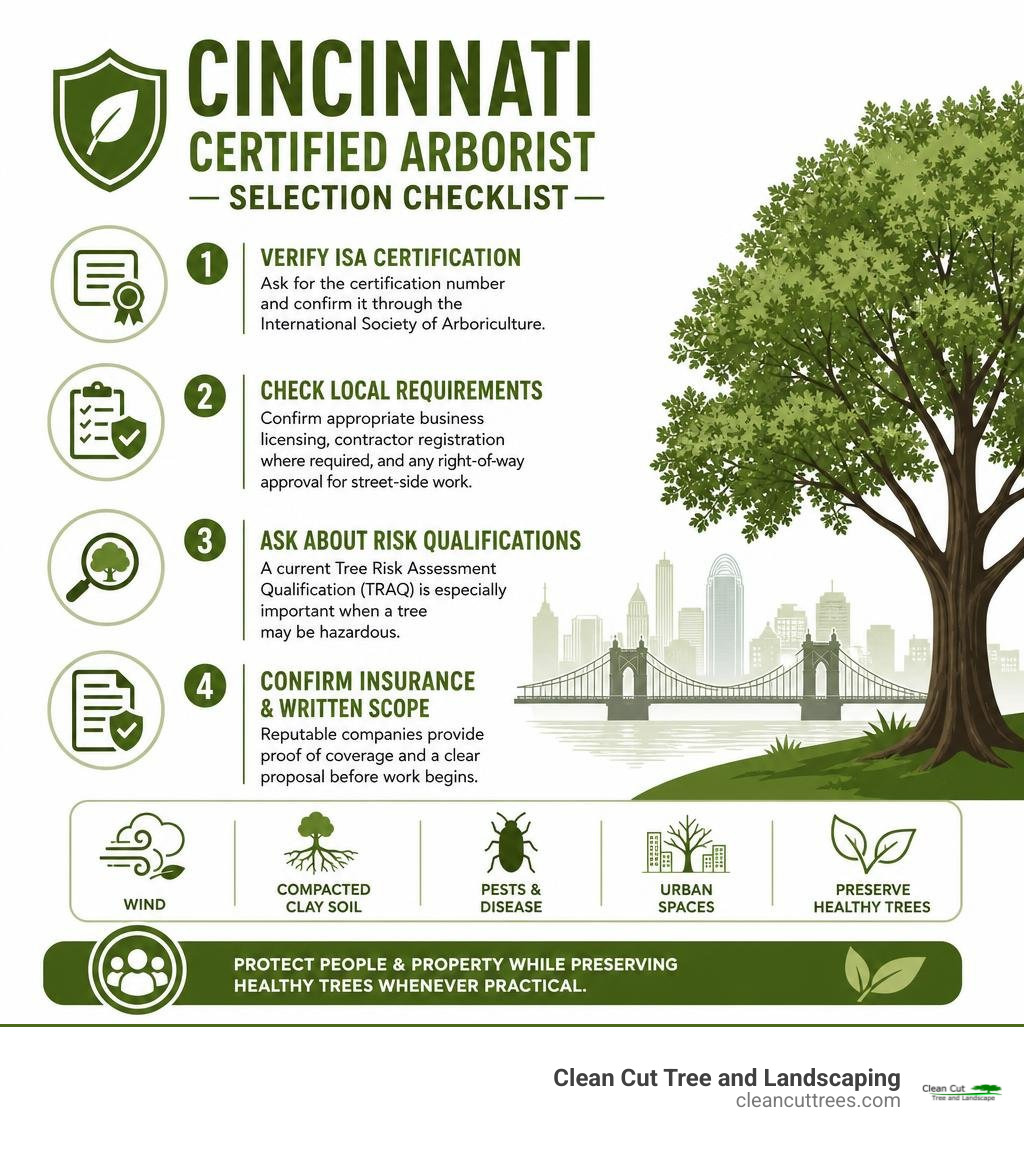
A certified arborist Cincinnati homeowners can trust should hold an active ISA credential, understand local tree risks, and be properly registered or licensed for the work they perform. For hazardous trees, storm damage, pruning, stump grinding, or long-term tree health, choose a provider who can explain the recommended work clearly and follow applicable Cincinnati and Ohio rules.
- Verify ISA certification: Ask for the arborist’s certification number and confirm it through the International Society of Arboriculture.
- Check local requirements: Cincinnati-area providers should carry appropriate business licensing, contractor registration where required, and any right-of-way approval needed for street-side work.
- Ask about risk qualifications: A current Tree Risk Assessment Qualification (TRAQ) is especially important when a tree may be hazardous.
- Confirm insurance and a written scope: Reputable companies provide proof of coverage and a clear proposal before work begins.
Greater Cincinnati’s mature oaks, maples, sycamores, walnuts, and ornamental trees face wind, compacted clay soil, pests, disease, and tight urban growing spaces. The right arborist helps you protect people and property while preserving healthy trees whenever practical.
We are The SEO Team, and next we will cover what separates a qualified Cincinnati arborist from a crew with only cutting equipment.
Why You Need a Certified Arborist Cincinnati Property Owners Can Trust
Trees in urban and suburban environments face unique challenges that wild forest trees never encounter. Compacted soil, restricted root zones, overhead power lines, and underground utilities all put stress on a tree’s structure. When you hire a certified arborist Cincinnati property owners rely on, you get a dedicated specialist who understands complex tree biology rather than someone who simply operates power equipment.
At Clean Cut Tree and Landscaping, we believe that informed property owners make the best choices for their trees and landscapes. Certified arborists adhere to strict industry standards established by the International Society of Arboriculture (ISA). They follow ANSI A300 standards for tree pruning and care, ensuring every cut made promotes long-term health rather than introducing decay or structural instability. Furthermore, all arboriculture operations must strictly observe ANSI Z133 safety specifications to safeguard workers, bystanders, and surrounding structures during complex tree operations.
By working with certified professionals who hold advanced credentials like the Tree Risk Assessment Qualification (TRAQ), you gain precise insights into potential structural flaws, internal decay, and soil conditions before a minor issue transforms into a catastrophic storm failure.
What Makes an ISA Certified Arborist Cincinnati Experts Different
Earning ISA certification requires passing a comprehensive exam covering tree diagnosis, maintenance practices, soil sciences, safety, and tree biology. To maintain certification, arborists must complete extensive continuing education units (CEUs) and adhere to a strict professional code of ethics.
Top arboriculture professionals often hold specialized credentials and background experience. For instance, industry leaders such as Nicholas Johnson, a Board Certified Master Arborist (BCMA) and Registered Consulting Arborist (RCA), demonstrate how deep scientific knowledge shapes municipal urban forestry and construction impact evaluations. Similarly, professionals like Zach Pollard, who brings over 16 years of experience including work with municipal park systems, highlight how technical climbing and TRAQ qualifications elevate field safety.
A dedicated climbing arborist, such as Ellis Kenady, combines hands-on climbing agility with TRAQ qualifications to inspect upper canopy conditions that ground crews simply cannot see. Specialist consultants emphasize conservative pruning methods and organic soil health, reinforcing the philosophy that tree care should focus on long-term preservation whenever possible.
When working with qualified tree specialists, you see how trained arborists focus on preserving mature trees through dynamic cabling, root management, and structural training rather than defaulting to unnecessary tree removals.
Services Offered by a Certified Arborist Cincinnati Homeowners Rely On
Professional arborists deliver a complete continuum of urban forestry services designed to enhance both safety and ecological health across residential and commercial properties:
- Structural Pruning & Crown Thinning: Executing selective cuts according to ANSI A300 guidelines to improve sunlight penetration, reduce wind resistance, and remove dead or crossing branches.
- Hazard Tree Assessment & Removal: Using specialized rigging techniques and heavy machinery to safely dismantle hazardous or dying trees in tight spaces near homes and power lines.
- Stump Grinding & Site Remediation: Grinding tree stumps below grade level to allow lawn re-establishment or landscape redesign.
- Structural Support Systems: Installing dynamic cobra cabling, through-bolting bracing systems, or custom prop supports to stabilize split limbs or leaning trunks.
- Plant Health Care (PHC) Programs: Multi-season monitoring that includes organic soil fertilization, microbiome regeneration, and targeted pest and disease management.
- Root Zone Excavation: Utilizing air knives to relieve soil compaction and inspect girdling roots that choke mature trees.
Cincinnati Tree Regulations, Right-of-Way Rules, and Permit Requirements
Navigating municipal regulations is a crucial step when planning any major tree work in the Cincinnati area. Rules can vary depending on whether the tree is on private property, in a public right-of-way, near a utility corridor, within a protected development area, or subject to a local zoning or hillside regulation.
Property owners should confirm requirements before scheduling major pruning, land clearing, or tree removal. In general, work on public street trees, sidewalk planting strips, or public right-of-way areas requires coordination with the appropriate Cincinnati or local municipal department. Private-property tree work may also require approval in specific circumstances, especially when development, grading, protected areas, or replacement planting rules apply.
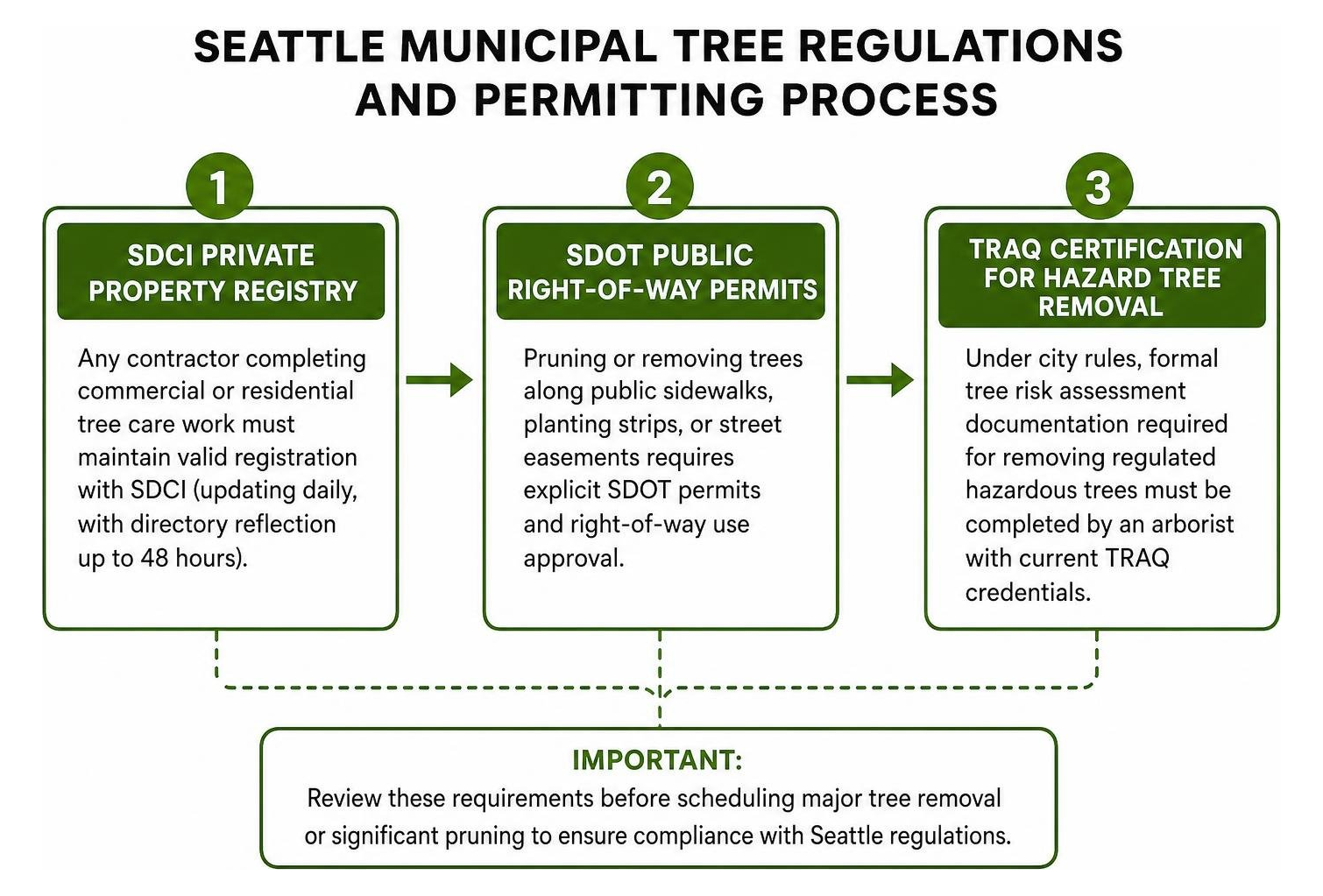
Before scheduling major tree removal or significant pruning, review these core regulatory considerations:
- Private Property Rules: Ask your local building, zoning, or urban forestry office whether the tree is regulated because of location, size, development activity, steep slope conditions, or neighborhood requirements.
- Public Right-of-Way Approval: Pruning or removing trees along public sidewalks, planting strips, street easements, or road frontage may require explicit local approval before work begins.
- TRAQ Certification for Hazard Tree Decisions: When a tree may be hazardous, formal risk documentation from an arborist holding current Tree Risk Assessment Qualification (TRAQ) credentials can help support safe, defensible decisions.
- Replanting Expectations: Some municipal approvals, development projects, or landscape plans may require replacement trees to help maintain neighborhood canopy over time.
Tree Health Management: Pests, Diseases, and Pruning vs. Removal
A primary advantage of hiring a certified arborist Cincinnati locals trust is early diagnosis of damaging pests and diseases. Ohio trees encounter localized threats that require precise Plant Health Care (PHC) interventions:
- Emerald Ash Borer (EAB): An invasive, destructive beetle that has caused severe ash decline across Ohio. Warning signs include D-shaped exit holes, S-shaped larval galleries beneath bark, canopy thinning, and heavy woodpecker activity.
- Lace Bugs: Feeding insects that cause leaves to take on a bleached, chlorotic look with small black fecal drops on leaf undersides, distinguishable from spider mites by the lack of silky webbing.
- Bronze Birch Borer: Targets stressed birch trees, causing canopy thinning, upper branch dieback, and distinctive swollen ridges along the trunk.
- Sooty Bark Disease (Cryptostroma corticale): A serious fungal infection affecting maples, visible as dark sooty spore masses beneath peeling bark.

Understanding the distinction between pruning, trimming, and removal is essential for maintaining property value and tree longevity:
- Tree Trimming: Typically refers to minor aesthetic shaping of superficial foliage or light hedge maintenance.
- Tree Pruning: A science-based practice focused on removing structural defects, deadwood, and diseased limbs to enhance long-term structural integrity and plant safety.
- Tree Removal: The complete, controlled dismantle of a tree down to ground level when it presents irreversible health decline, structural failure, or an unmitigable hazard.
Proactive tree management also involves soil enhancement. Applying 2 to 3 inches of organic mulch around the dripline, while keeping mulch several inches away from the trunk base, helps retain moisture, suppresses weeds, and insulates root systems from sudden temperature swings.
Emergency Tree Removal and Storm Damage Response
Ohio thunderstorms, high winds, saturated soils, and freeze-thaw weather can cause sudden branch failure or uprooting. When mature shade trees fail near homes, driveways, fences, or utility lines, immediate intervention is essential.
At Clean Cut Tree and Landscaping, our emergency response teams deliver rapid, same day tree removal to mitigate immediate threats and secure storm-damaged properties safely across the Greater Cincinnati area.
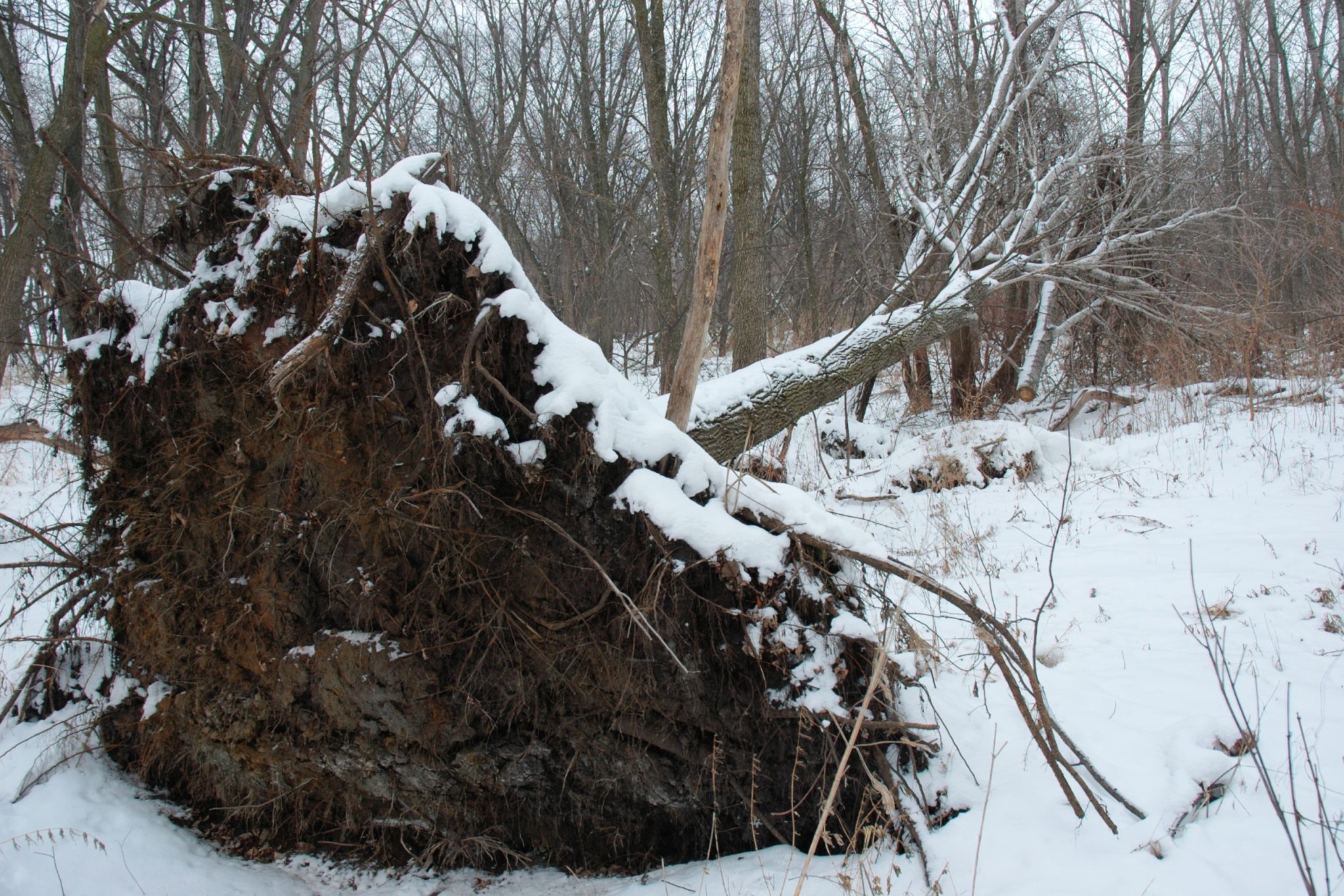
Watch out for these urgent structural warning signs on your property:
- Fresh soil heaving or root plate lifting near the base of a mature tree.
- Deep, visible splits or cracks opening in major trunk unions following high winds.
- Large broken branches hanging high in the canopy (“widowmakers”) over pathways or roofs.
- Unexplained sudden lean developing in a previously upright tree.
- Bark sloughing off with decaying wood exposed beneath after heavy weather.
Using specialized rigging gear, heavy equipment, and experienced arborists, hazardous trees can be safely dismantled in tight spaces without causing secondary damage to your home or neighboring properties.
Cost Guide for Cincinnati Tree Care Services
Tree care investment varies based on species height, location accessibility, proximity to structures, and overall project complexity. While consulting arborists may charge standard hourly or site visit fees for written TRAQ risk evaluations, routine pruning and removal projects depend on equipment, crew size, rigging needs, and labor requirements.
The comparison table below provides a general operational overview of standard tree care service scopes across the region:
| Service Category | Primary Focus & Scope | Common Applications | Key Safety & Regulatory Factors |
|---|---|---|---|
| Light Pruning & Trimming | Aesthetic clearance, roofline clearance, deadwood removal | Trees under 12-15 feet, fruit trees, hedges | ANSI A300 compliance, proper pruning cuts |
| Structural Pruning & Wind Resistance Reduction | Crown thinning, structural shaping, reduction of storm-related limb loading | Mature oaks, maples, sycamores, walnuts, and ornamental trees | Dynamic cabling, aerial climbing gear, drop zone safety |
| Hazardous Tree Removal | Technical dismantling, rigging, crane assisted removal | Severely decayed, split, or hazardous trees near homes | TRAQ assessment when needed, local permits or right-of-way approval, same day tree removal response |
| Stump Grinding & Root Care | Sub-surface grinding, root zone excavation | Post-removal site clearing, girdling root remediation | Utility line clearance, organic soil backfilling |
Frequently Asked Questions About Cincinnati Tree Care
How Do I Verify a Cincinnati Tree Service Provider Registration?
You can verify whether a company is qualified to operate by asking for proof of business licensing, contractor registration where required, general liability insurance, workers’ compensation coverage, and individual arborist ISA or TRAQ credential numbers. For work on street trees or public right-of-way areas, contact the appropriate Cincinnati or local municipal department to confirm whether additional approval is required before the project begins.
When Should I Call for Emergency Tree Removal in Cincinnati?
You should seek same day tree removal services immediately if you notice a tree actively leaning toward a home, visible root plate movement, large cracked limbs suspended over living spaces, or trunk failure following a major storm. Do not approach fallen trees touching utility lines; contact utility providers immediately.
Do I Need a Permit for Tree Removal on Private Property in Cincinnati?
A permit is not required for every private-property tree removal, but approval may be needed depending on the tree’s location, development activity, right-of-way impact, protected site conditions, zoning requirements, or local municipal rules. If a tree is hazardous, documentation from a TRAQ-qualified arborist can help support the decision to remove it safely and may be useful when local review is required.
Conclusion
Caring for urban trees requires balancing ecological preservation with property safety. By selecting ISA-certified professionals who respect local requirements, maintain proper licensing and insurance, and apply science-backed Plant Health Care principles, you safeguard your Greater Cincinnati landscape for years to come.
Whether you need routine crown thinning, pest diagnostics, stump grinding, land clearing, or rapid emergency response, Clean Cut Tree and Landscaping provides expert support tailored to your property. Visit our Emergency Tree Services page to learn more about how our certified team handles complex tree removals and storm cleanup safely.